Category: strength

Do you need a vacation from illness?


Ever feel like you need a vacation from cancer, dementia, ALS, heart disease or whatever health trial you’re facing?

You probably do—at least a mental one and maybe a physical one as well.

Believe it or not the chemo room at Dr. Marc Hirsh’s office, where I worked as a patient advocate for nearly 20 years, became a mini-vacation from cancer for patients when we threw elaborate parties for two days near Halloween. 

One year it was a Sesame Street theme and I obliged as Miss Piggy (For the record, I “porked up” with eight pairs of rolled up socks under my skirt and down my blouse!)

Another year we dressed  up as  the Wizard of Oz with the good and bad witches giving chemo. I covered my whole yellow-clad body with a long piece of yellow shelf paper outlined in brick shapes.  “Follow the yellow brick road!” I announced in my best Munchkin voice as I led patients back to the chemo room.

You’ve probably heard of the non-profit organization Make-a-Wish which grants wishes for children facing a life-threatening illness—often a trip to Disney World or a chance to meet a famous athlete or movie star.  But did you know there are groups which offer free wishes for adults with cancer and other life-threatening illnesses?

When I worked as an advocate I helped several people get free dream wishes. A young mom went to Disney with her husband and 4-year-old. Another family got a free week’s vacation at a beautiful Delaware beach home and a mother of four, who had just finished treatment got a much-needed holiday in Myrtle Beach.

If you Google “adult cancer patient wishes” a slew of them come up. The rules are different for each wish—some are only available to certain ages or specific kinds of cancer, while others include any life-threatening illness. Some are based on financial need—like if you can’t afford a vacation yourself.

There are dream wishes for everything from fly-fishing excursions to free house cleaning. Normally you can only have one wish granted, so choose wisely before applying. Ask a nurse/patient navigator or a hospital social worker to help you with the paperwork because usually you can’t nominate yourself. If you don’t have the energy to apply, but need a dream vacation, ask a trusted friend or family member to take the lead and make it happen. I’m sure someone would be thrilled to have a specific way to lighten your load.

My friend Barb Titanish and her wonderful organization H.O.P.E., which ministers to hundreds of cancer Hopelinepatients and their families is actually in the process of creating a retreat in southcentral Pennsylvania where folks can have a vacation from cancer. Plans call for the 49-acre donated site to have a fully staffed main house with four to six family suites, catered dining facilities, a fishing pond, greenhouse, hair salon, serenity garden, and playground including a handicapped accessible treehouse. Folks can come for the day or the week.

“Whether you are just diagnosed or starting a new treatment or at the end of life, you need to give yourself a break,” says Barb.  (You can follow the project’s progress at www.hopeforcancerfamilies.org)

You also can create a mini-vacation from your illness right in your own home or town. Declare every first Friday of the month to be “Cancer-Free Friday” where you only watch funny movies and no one is allowed to mention the “C” word. Or ask a friend to plan an outing for the day—a scenic ride and a picnic, a mani-pedi and a tea room, or an afternoon hitting golf balls and eating BBQ. Ask yourself what would help your mind/your body/your spirit to take a vacation from illness. Pray about it and ask God how you or someone you know can make it happen. People cannot read your mind so let those who have asked to help you know what you really need.

You deserve a break today…and I’m not thinking McDonald’s.

I am sick at heart.
How long, O Lord, until you restore me? Psalm 6:3

When they walk through the Valley of Weeping, it will become a place of refreshing springs. The autumn rains will clothe it with blessings. Psalm 84:6

Adapted from Peace in the Face of Cancer, copyright 2017 by Lynn Eib
+++++++++++++++++++++++++++++++++

(If the music video below doesn’t automatically load, click on https://www.youtube.com/watch?v=p9zEgRsorZ4 )

Happy Trails to You!


Did I ever tell you about the time I sang in church with Roy Rogers

It was the fall of 1969 during my senior year of high school and my family was newly attending a small church in Apple Valley, California. One Sunday morning the four of us traipsed into the little sanctuary toward a partially filled row. For some reason my eighth-grade brother, Jim, tried to squirm past me to get to the row first. Like a typical, annoyed older sister, I pushed him back and told him to sit on the end by Dad like he always did.

After we were seated, I silently snickered as I checked out the man on my left: very uncool cowboy boots; dorky bolo tie; gaudy gold wristwatch with big red gems and a bear head. Looks like a real hick.

I finally glanced at the man’s face and then whispered to my little brother, “Doesn’t this guy look like Roy Rogers if Roy Rogers was really old?”

My brother’s bony elbow jabbed my ribs as he loudly whispered back, “You, stupid, that is Roy Rogers!”

I gulped, scooted my chair closer to Roy, and when he offered to share his hymnal on the first song, took hold of it and sang my heart out with the King of Cowboys![1]

I hope you know the “Happy Trails” melody which signed off TV episodes of the Roy Rogers Show.[2] It’s a soothing, feel good song, which seems rather inappropriate for the unhappy trail of serious illness and other trials of life:  Happy trails to you, until we meet again. Happy trails to you, keep smilin’ until then. Who cares about the clouds when we’re together? Just sing a song and bring the sunny weather.”

But listen to the song’s second verse:

“Some trails are happy ones,
Others are blue.”

Roy and Dale could have kept on making movies at that age...They look great!Roy and Dale, married for 50 years, had plenty of “blue” trails—three prior, short, failed marriages for Dale beginning at age 14; the death in childbirth of Roy’s first wife; toddler daughter Robin’s death from Down Syndrome complications; and the deaths of two of their four adopted/foster children—12-year-old daughter Debbie in a bus accident; and son Sandy, who choked to death while serving in the U.S. Army.

I can only imagine how many times Roy and Dale had to remind themselves of the rest of that verse:

“It’s the way you ride the trail that counts,
Here’s a happy one for you.”

So you’re on an extremely blue trail—how are you going to ride it?

 Therefore, we do not lose heart. Though outwardly we are wasting away,
yet inwardly we are being renewed day by day.  For our light and momentary troubles are achieving for us
an eternal glory that far outweighs them all. So we fix our eyes not on what is seen, but on what is unseen, since what is seen is temporary, but what is unseen is eternal. 1 Corinthians 4:16-18

Faith is the confidence that what we hope for will actually happen;
it gives us assurance about things we cannot see. Hebrews 12:1

We ride our “blue trails” by faith and not by sight. And that’s how we find a new perspective as God sets us “high above.”


His house is my shelter and secret retreat.

It is there I find peace in the midst of storm and turmoil.
Safety sits with me in the hiding place of God.
He will set me on a rock, high above the fray. Psalm 27:5 The Voice Bible

Happy Trails to you, my friend, until we meet again.


[1] I laugh whenever I recall this incident because I’ve looked up Roy’s birthdate and know he turned 58 in November 1969—obviously “really old” to my 16-year-old eyes!

[2] You can listen to the original version online https://www.youtube.com/watch?v=hgw_yprN_-w or later versions by Van Halen and Randy Travis among others.

(If the music video below doesn’t automatically load, click on https://www.youtube.com/watch?v=M3TbAMExY_w)

Helping Kids Cope with Cancer and Celebrating One Boy’s CURE


One of our church’s pastors, Matt, and his wife Carrie have been living in the shadow of cancer since December 2009, when their oldest child, Ian, was diagnosed with acute lymphocytic leukemia at the age of 3 ½ .

Matt vividly recalls the moment the doctor gave them the diagnosis. 

“Acute leukemia were not the words we expected to hear,” Matt says. “In my mind, I equated that (diagnosis) with death and I thought I was going to lose my son.”

Later that night after the frightened couple put Ian and younger brother Nathan, then 1 ½ , to bed they joined hands and “told God we fully gave Ian to Him,” Carrie recalls.

“We prayed for our marriage to be able to withstand the stress that was about to come upon us,” she adds.

Ian underwent six phases of aggressive chemotherapy over more than three years and was in and out of the hospital for treatment and its debilitating side effects.

I recently asked Carrie and Matt how they helped their young family, which now includes a daughter, Quinn, see God at work in the midst of this trial.

“We openly discussed our fears and when we felt alone and even distant from God,” Carrie explains. “We also served in our ‘cancer community’ by showing God’s love in practical ways to others who were suffering, too.”

A couple of years ago, Ian and his family loaded up their van to go out to eat and celebrate his third cancer-free anniversary. Carrie recalls:  “I noticed Ian sitting there with his eyes closed and hands folded. I wasn’t sure if he was praying, so I asked him if he was OK.”

“Yes,” was the young survivor’s reply. “I was just thanking God that I’m still cancer-free.”

On February 27, 2018–five years after Ian finished treatment– doctors officially pronounced the 11-year-old CURED! He and his extended family joyfully celebrated with a Disney cruise vacation.


Every year nearly 16,000 children in the U.S. are diagnosed with cancer and worldwide about a quarter of a million kids get that bad news. That’s a new child diagnosed with cancer every three minutes.

Statistics are not compiled for how many parents of minor children get cancer, but about 3.2 million of the U.S. adults diagnosed annually are ages 21-55 and therefore likely to still have kids at home. And that’s not even counting all of those cancer patients with young grandchildren.

However you add it up, there are a millions of families facing cancer with children.

So how can you best help the children in your life?  Fred Rogers has been quoted as saying: “Anyone who does anything to help a child in his life is a hero to me.”  So here are my recommendations written in an A- B-C style in honor of my hero, Mister Rogers:

  • Allow your feelings to be seen—even the sad ones. Obviously, it’s our job to help our children with their feelings, not vice versa, but if you want them to see how God is walking with you, you’ll need to share your struggles at times. It’s OK for children to know that sometimes we are afraid or angry or worried because then we can show them how a Christ-follower seeks God’s help with those feelings.
  • Be age-appropriately honest. Don’t tell all the statistics, but do use the word “cancer.” If you don’t, it may seem as if the word is too scary to even utter. It isn’t. Take away some of its supposed power by naming it as simply another illness. Sometimes when we don’t tell children the difficult truth, they imagine something even worse.
  • Create ways kids can give of themselves. Let them make cards or little gifts for the one facing cancer. Encourage them to pray specifically for that person every day. If the child is the one with cancer, follow Ian’s family’s lead and minister to others going through hard times. It’s so much easier to get our minds off our own troubles when we reach out to others.
  • Don’t make promises you can’t keep. We never told our girls “Mommy will be fine” because there was no such guarantee. We did promise them that the doctors would do everything they could to make me well, I would do everything to get well and that we expected I would become well.
  • Empower them by praying for them and with them—as in out loud and not just at mealtimes. Show them how to trust God even when we don’t like our situation. Don’t promise them that the one with cancer will be healed, but promise them that the One who created that person loves him/her with an everlasting love and will never leave them.

Facing cancer with children can be a wonderful first-hand lesson of the supernatural power of God in our lives. Help guide them to the path of peace as the Lord guides you there, too. The positive impact of this journey can be seen for generations to come.

Our children will serve Him;
future generations will hear the story of how the Lord rescued us.
They will tell the generations to come
of the righteousness of the Lord,
of what He has done. Psalm 22:30-31 The Voice Bible

Adapted from a chapter in Peace in the Face of Cancer, copyright 2017 by Lynn Eib.

(For parents with cancer, I recommend When a Parent Has Cancer: A Guide to Caring for Your Children by Dr. Wendy Harpham. For parents of children facing cancer, I recommend Chase Away Cancer: A Powerful Story of Finding Light in a Dark Diagnosis by Ellie Poole Ewoldt.)

If the music video doesn’t appear, use this link https://www.youtube.com/watch?v=Uy2EtG3UkL8


 “Do one thing every day that scares you.”

I love this quote attributed to Eleanor Roosevelt. I can only imagine how many “scary” things this American First Lady had to do each day. She was described as a shy child and was orphaned by age 10. Later her husband, Franklin D. Roosevelt, was stricken with polio, necessitating her expanded role in his political career. Eventually she became the first First Lady to speak out on political and humanitarian issues, for which she was both strongly criticized and enthusiastically praised. I wonder if she woke up each day reminding herself: Do one thing today that scares you.

That’s probably a good mantra for those facing serious trials and their caregivers—although some days you may have to do several things that scare you!

A post appearing online in recent years asserts that the phrase “Fear not” appears in the Bible exactly 365 times—one for each day of the year. The first time I saw that post, my natural reaction—as a reporter who needs two sources to verify anything—was to look it up and count them for myself.  I turned to BibleGateway.com and discovered the King James Version uses that phrase 64 times—exactly .1753424 times for each day of the year.

Okay, just because it’s not listed 365 times doesn’t mean it’s not good advice for every single day.  So what do we do with our understandably fearful reactions?

There’s a great story in the Bible which I believe offers some clues. It’s found in 2 Chronicles 20. The Jewish king Jehoshaphat was told that some great armies were coming to attack Jerusalem. His reaction was not atypical from what ours might be—he “was terrified” and then he “begged the Lord for guidance” (2 Chronicles 20:3). Shortly, God answered that prayer by sending His Spirit to speak through one of the king’s men:

He said, “Listen, all you people of Judah and Jerusalem! Listen, King Jehoshaphat! This is what the Lord says: Do not be afraid! Don’t be discouraged by this mighty army, for the battle is not yours, but God’s. Tomorrow, march out against them. You will find them coming up through the ascent of Ziz at the end of the valley that opens into the wilderness of Jeruel. But you will not even need to fight. Take your positions; then stand still and watch the Lord’s victory. He is with you, O people of Judah and Jerusalem. Do not be afraid or discouraged. Go out against them tomorrow, for the Lord is with you!” 2 Chronicles 20:15-17

The king and his people agreed to “fear not”—instead they believed God and began to worship Him, praise Him, and sing to Him. At the very moment they did this, the Bible says God caused the approaching armies to fight amongst themselves and kill each other. The Israelites won the battle without a fight because God fought for them.

Logically, standing still does not sound like a good way to win a battle. But then God’s ways are not our ways, are they? The armies coming against Jehoshaphat were way too large and powerful to be defeated by him. The situation was hopeless from his perspective—but it was hope-filled from God’s vantage point. All the king had to do was acknowledge his fear, pray to God and then stand still.

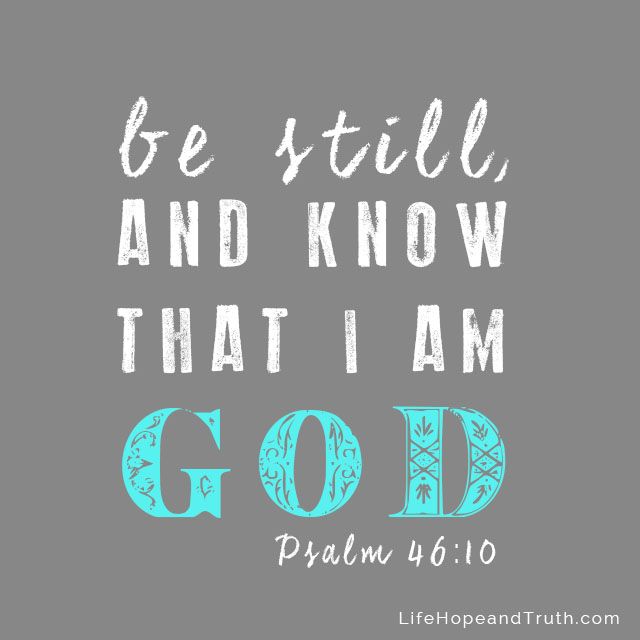
One of the most difficult admonitions in Scripture for me to follow is Psalm 46:10: “Be still and know that I am God.” 

The word translated still in Psalm 46:10 is the Hebrew word harpu. I’m no Hebrew scholar, but I did some research and found it conveys the idea of ceasing to act or letting go. It’s the opposite of striving with our arms up, ready to fight or at least defend ourselves.

I know that we talk about “battling” cancer or other illnesses, but I also think that at times we need to quit striving, acknowledge our fears, surrender the fight to God and release His power to work in our situation.

Perhaps the scariest thing God is calling you to do today is to “be still” and trust Him.

The LORD is for me, so I will have no fear. What can mere people do to me? Psalm 118:6 NLT

COURAGEOUS PEACE REPLACES fear when we are still and know He is God. (This post is excerpted and adapted from Peace in the Face of Cancer, copyright Lynn Eib 2017.)

[1] Although this quote is widely attributed to Eleanor Roosevelt, including in a 2013 book by the same name, I could not verify any original sources. The earliest verifiable print source with this phrase appears to be a June 1997 Chicago Tribune advice column by Mary Schmich. But even if Mrs. Roosevelt didn’t utter this sentiment, I think she lived it!

(If the music doesn’t load, please use this link https://www.youtube.com/watch?v=p0B-yfgmezM)

Given No Hope–Alive and Well 50 Years Later


“There is something you must always remember.
You are braver than you believe, and stronger than you seem, and smarter than you think.”
Christopher Robin to Winnie‑the‑Pooh in Pooh’s Most Grand Adventure

I love these words of encouragement from one best friend to another. They were the sentiment of a life-changing pep talk given to me in high school by my dear friend Cecil, who is the first person I knew who survived cancer.

We met in a speech class in the fall of 1968. I was a junior and he was a sophomore at Victor Valley High, where he was without a doubt the best orator. When he chose me to be his debate partner, I was thrilled. I didn’t know that the year before he had been diagnosed with fibrosarcoma (a rare cancer of the soft tissue), only that he always had a large Band-Aid on his forehead and that its self-described “flesh” color did not match his black skin. 

I’m not sure if either one of us ever used the “C” word. In the sixties, cancer was something adults whispered about and doctors tried to keep from patients’ knowledge.

“Why do you always wear a Band-Aid?” I naively asked him one day.

“Because I’m very embarrassed about my scars” was his quiet reply.

The scars were the result of multiple surgeries—beginning when he was fifteen—to try to cut away the cancer and extend his life.

“The fibrosarcoma was eating through my skull,” Cecil explained as we chatted on the phone about this chapter.

Back then chemotherapy was in its infancy, and radiation therapy couldn’t possibly be safely aimed at a patient’s head, so his doctors simply sliced away, waited for the cancer to grow back, and then cut it out again.

By the fall of 1968, doctors were so pessimistic about Cecil’s future, they recommended he drop out of high school. “Once it hits the optic nerve, it will go right to the brain. Go home and don’t even worry about school anymore,” they advised.

But Cecil had other plans.

“Not only am I going to go back to school, I’m going to graduate,” he told them. “And not only am I going to graduate, I’m going to go to college. And not only am I going to go to college, I’m going to go to the best college!” he defiantly added.

His equally strong-willed mother approved, saying, “If you want to go back to school, it’s fine with me. I don’t want you to just lie down and die.”

So Cecil went to school, ran track, and played basketball and football, wearing a customized helmet to protect his forehead as he darted downfield with the ball. (Bet that wouldn’t be allowed these days!) Just about every Saturday for the next two years, we were together at a speech meet or a debate competition, eventually becoming the first students from our school to make it to the speech state championships.

But in the summer of 1970, right after I graduated, Cecil’s cancer came back, and more surgery ensued. The hole in Cecil’s forehead was getting rather large, so doctors stitched his left forearm to his forehead for six weeks in an attempt to graft skin there. However, in the fall of 1970, the relentless cancer returned.

Surgeons wanted to operate again and now sew his right arm to his head, but his mother refused. She moved him to another hospital, ignoring the doctor’s warning that if she did he’d be “dead in two weeks.”

Physicians at the new hospital did the same kind of surgery, without stitching his arm to his head. At Cecil’s first recheck, they were pleasantly surprised the cancer had not returned. Three months later, they were shocked to find no sign of it. Three more cancer-free months later, they were speechless.

“We can’t take any credit for this, because we didn’t do anything different from the other doctors,” they told the then-eighteen-year-old Cecil. “The fibrosarcoma was like a runaway freight train on a dry, straight track, and it just stopped. In medicine we call it a spontaneous remission.”

Cecil finished high school, serving as student body president, and went on to graduate with honors from Harvard University, where he played football, ran track, and coached the debate team. As I write, he is a sixty-three-year-old longtime university law professor with many accolades and former students across the country who say his teaching expertise and friendship changed their lives.

“Despite all the dark predictions, I’m alive and doing just fine,” he says. “I believe to this day that God healed me despite all the gloom and doom. And it has never come back because He had other plans for me.”

I’m so grateful that meeting Cecil was part of God’s plan for my life. Before we participated in our first debate meet, I was scared and not at all confident in my speaking and writing abilities. I felt insecure because I was the youngest in my class (I graduated at sixteen) and because my father’s job had forced me to twice move midyear to new high schools. But Cecil shared words very similar to Christopher Robin’s with me, and I took them to heart. And as they say, the rest is history.

When we face the trials of life. including cancer, we discover the incredible strength of the human spirit as we do things we never thought we could. But I hope you also are discovering that the greatness of God is the reason you are braver, stronger, and smarter than you realized.

Find a mirror, look straight into it, and tell yourself: “I am braver than I believe. I am stronger than I seem. I am smarter than I think. God is much greater than I can imagine.”

And then share those words today with someone else who needs to hear them. You never know how God may use them to change a life.

(If the music video doesn’t automatically load, please use this link https://www.youtube.com/watch?v=Cb4o4lN0c_E&list=RDCb4o4lN0c_E&t=23 )