Don’t Waste Your Cancer


Those are the words penned by author-pastor John Piper on the eve of his surgery for prostate cancer in 2006. Our cancer support group often spent a meeting discussing one of Piper’s ten ways we can “waste” cancer by allowing it—instead of God—to be foremost in our lives. (You can read his wonderful essay at www.desiringgod.org) Many in our group have embraced Piper’s admonition and often remarked: “I don’t want to waste this cancer.”

Probably the cancer survivor who most often expressed that sentiment is my friend Bert, diagnosed in December 2003 with stage 4 prostate cancer at the age of sixty-eight.

Bert’s cancer was not operable, so he underwent eight weeks of radiation and eighteen months of hormone shots to try and slow its course. The radiation went fairly well, but the shots, which “turned off” his male hormones gave him severe hot flashes.

“That gave me a greater appreciation of what women go through in menopause and I sure don’t want to go through childbirth!” Bert admits with a smile.

Because Bert’s father and grandfather both had faced cancer, he wasn’t particularly stunned to get his diagnosis.

“I was surprised and concerned, but I had a peace about it,” he recalls. “I remember thinking that I could go home and feel sorry for myself—but I would still have cancer—or I could use it to show people that I’m not afraid to die. I’ve decided I will use cancer to share and encourage other people.”

Don’t waste your cancer.

That’s the decision Bert made many years ago. Since then his yearly PSA readings are in the normal range as he continues to be in complete remission from the cancer. But he has been told by doctors to expect it to come back at some point.

“Can it come back? Yeah,” he says. “Am I afraid of that? No.”

Bert says his peace about his uncertain future comes from the fact he is a “Christ-follower.”

“I love to explain to people what that means,” he adds. “I like to ask people ‘where is your hope?’ and I like to share with them that my hope is in following Christ.”

I am so glad that Bert decided not to waste his cancer. I can’t begin to tell you all the folks in our support group he has encouraged in their cancer fight, as well as many others in his church and community.

I’d like to think I haven’t wasted my cancer either. I’ll admit I initially was rather reluctant (OK, very reluctant) to minister to cancer patients and their caregivers. But the more I reached out to hurting people, the more I got blessed, too. I realized I couldn’t go back and change my diagnosis, my treatment or even my prognosis, but I could make sure that all the pain I endured was not wasted. I had suffered on my cancer journey, but I also had been comforted by God and I could share that truth with others. As the Apostle Paul explains in 2 Corinthians 1:3-4:

God is our merciful Father and the source of all comfort. He comforts us in all our troubles so that we can comfort others. When they are troubled, we will be able to give them the same comfort God has given us. 

Whatever you and your family have suffered—whatever hardship still lies ahead for you—will you ask God today to help you not waste it?

Piper wrote that “Christians are never anywhere by divine accident. There are reasons for why we wind up where we do. Consider what Jesus said about painful, unplanned circumstances: ‘They will lay their hands on you and persecute you, delivering you up to the synagogues and prisons, and you will be brought before kings and governors for my name’s sake. This will be your opportunity to bear witness.’ (Luke 21:12 -13). So it is with cancer. This will be an opportunity to bear witness. Christ is infinitely worthy. Here is a golden opportunity to show that he is worth more than life. Don’t waste it.”

Heavenly Father, I wish I didn’t have to face cancer, but because I do, I’m asking You to help me not to waste it. Please take these painful, unplanned circumstances and turn them into an opportunity for me to show others that You are worth more than life itself. In Jesus’ Name, I pray. Amen.


https://www.youtube.com/watch?v=SvnW9shg3YA

When Your World Falls Apart


So where were you when the events of 9/11 unfurled? I bet you know exactly. I vividly remember I was standing in the chemo room at our oncology office chatting with patients when the first plane hit.

And if you’re OLD like I am, you recall where you were when President Kennedy was shot in 1963. I know I was at Debbie Walls’ house playing the Barbie game (and poised to secure the good-looking bachelor, Ken, for my “date”) when Debbie’s stepmom rushed in with the terrible news. (Debbie found me on Facebook a few months ago after being out of touch for 50 YEARS and she told me she never forgot me either because of the incredibly sad memory we shared.)

It’s amazing how quickly your world can fall apart. One minute life seems pretty good, and the next minute you’re wondering how you ever will survive.

A health crisis has the ability to shake our worlds in ways difficult to comprehend. A while back, I surveyed a bunch of my cancer survivor friends for remembrances of the day their worlds fell apart.

“Surreal” is the term Wayne uses to describe how it felt to be told he had Stage 4 non-Hodgkin’s lymphoma at the age of forty-seven.

“My family, like myself was in shock—pure disbelief,” he recalls thirteen years later. “I recently had gone twenty years without missing a full day of work to illness and now I had cancer? I couldn’t believe it.”

Ken was equally surprised nine years ago when his tongue cancer finally was diagnosed after two years of reassurances that the enlarged lymph node was “nothing to worry about.”

“When the doctor finally did say the word ‘cancer,’ I was in total shock,” Ken recalls. “I had no symptoms and I was in great shape for a forty-six-year-old man! I told someone I felt as if I had entered the Twilight Zone and nothing was recognizable.”

Cathy says “denial and total shock” were the first two emotions she experienced after being told in November 2009 that she had breast cancer at age fifty-four.

“My husband’s and my emotions were very different,” she adds. “He was a lot calmer and stronger than I was.”

My nurse/reporter friend Cubby says disbelief also was her first reaction to a breast cancer diagnosis at age fifty-one.

“I froze and my husband’s face turned white,” she still vividly recalls six years later. “The worst part was the fear of the unknown.”

Fear of the unknown.

 I think that’s pretty much a universal response to a cancer diagnosis. The story of the day your world fell apart may be similar to these folks or it might be quite different, but I’m willing to bet that after those initial strong emotions wore off, you were left with the same question for yourself or your loved one: What’s going to happen next?

How difficult will the treatment be?

            Will I/they get sick?

            Can I/they keep working?

And the $64,000-question: Will I/they be cured?

I, of course, will answer all those questions for you in this blog…yeah, right. I have no magic tea leaves for your or your loved one’s future. I believe there’s a good chance that the treatments will be easier than you think because that’s what most of our patients say—the worry before the first chemo or radiation was worse than the actual treatment itself. I think you or your loved one probably will not get sick because there are wonderful anti-nausea drugs available today—at least three or four new ones since I was treated in 1990. (If you knew people treated a long time ago for cancer, please don’t imagine your experience is likely to be like theirs.)

I also think there’s a good possibility you or your loved one will be able to keep up a fairly normal life. I see cancer patients everyday in our office getting chemo and then heading out to their place of employment or home to do yard work. Most folks say they adjust to a “new normal” and enjoy the days with good energy, while resting more on the days when fatigue sets in.

And if you want to know the overall survival odds, 64% of adult cancer patients still are alive five years after their diagnosis, according to the National Cancer Institute.

Of course, I can’t promise my observations all will come true for you. I don’t know your future health any more than I am certain of my own. But I do know the One who does know it all.

For I know the plans I have for you,” says the Lord. “They are plans for good and not for disaster,
to give you a future and a hope. Jeremiah 29:11

What an incredibly comforting verse for us when our world falls apart. Just don’t miss that itty-bitty word “I” in the first sentence. “For I know the plans I have for you.”

Only God knows the plans for us and they are His plans and not necessarily ours. But whether His plans match ours or not, we can be confident they are good ones and designed to give us hope. Jeremiah 29:12-14 continues with God’s assurances:

In those days when you pray, I will listen. If you look for me wholeheartedly,
you will find me. I will be found by you,” says the Lord.

Thank You, Lord, that You are not watching me from a distance, but You are close by and hear me when I pray. Please help me to trust that Your plans for my life are truly good ones. Amen.

http://

How do you find peace in the face of cancer?


For years I’ve been wishing there was a book offering hope to those facing cancer which is not expected to be cured—not one on how to get ready to die, but one on how to keep living with cancer for the long haul. I wanted it to be a book for both patients and caregivers because when anyone in the family has cancer, it can feel like everyone does. And I really wanted it to encourage believers to trust in God despite life’s trials and to point seekers to a relationship with Jesus.  But I couldn’t find such a book.

So I wrote one.

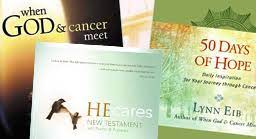
Eib wrapPeace in the Face of Cancer is slated to be released by Tyndale House in March 2017 and I’m so excited for the lives it will touch. And I’m especially excited that my editors pushed me to write it not just for those with incurable cancer, but for anyone, anywhere on a cancer journey. That made my writing task more difficult, but because of this broader scope, it’s a far better book with a far bigger audience—an estimated 14.5 million of us living with a history of cancer in the U.S. alone!

I heard a speaker at a recent Christian writers’ conference advise authors not to share a book cover until a month before its release because people will forget. But I am so happy about the cover I just couldn’t wait! (Besides I’ll “remind” you later.)  The cover is soft imitation leather like 50 Days of Hope and is just a little bigger (5×7 instead of 4×6). I love the shiny, gold foil stars and believe that looking up through the trees at a starry nighttime sky is a very peaceful feeling.

I’ll be sharing excerpts as the release date draws closer and more about how this is going to be the first in a new series by Tyndale. The second “Peace in the Face of…” book already has been contracted to a famous NY Times bestselling author! Stay tuned for details.

Because of God’s tender mercy, the morning light from heaven is about to break upon us, to give light to those who sit in darkness and in the shadow of death, and to guide us to the path of peace. –Luke 1:78-79 NLT


Amazing Cancer Patients


I knew her as “The Horse Lady” long before I ­ever knew her name was Nicola.

And if I was writing a brochure about amazing things cancer patients have done while ­under­going treatment, the Horse Lady would be my cover photo.

She got her nickname from Dr. Marc Hirsh, who initially had trouble remembering her name, but had no trouble bragging about her exploits to me even before I worked in his office. His favorite story was about how she loaded up one of her prized thoroughbred horses in her horse trailer, hitched it to her pickup, and drove all the way from Pennsylvania to Oklahoma. After delivering the horse to its new owner, she continued to drive herself to Mexico for a vacation.

“Drove the truck herself with her oxygen tank right beside her on the front seat!” Marc said with a satisfied smile. “She’s amazing!”

I’ve met a lot of amazing cancer patients.

 I know a man who earned his green belt for karate while being treated for lung cancer. I know a woman who went to dance class wearing a belt pump that released a continuous infusion of chemotherapy into her while she danced. I know another man who won a racquetball tournament a couple days after his treatment for widespread colon cancer.

My friend Leanna started running 5K races after her diagnosis of Stage 4 melanoma. She’s not super-fast, but at age sixty-eight, she’s usually quick enough to win her age category!

“I thought I’d give it a try to see if it would help me get better,” says Leanna, a grandmother of eleven who still works part-time babysitting neighborhood children and is in complete remission from the cancer. She’s even convinced her husband Larry, seventy, to compete in an upcoming race with her.

“He was going to enter in the ‘Clydesdale’ category for men who weigh over 200 pounds,” she says, “but I told him he might have a better chance of winning the ‘70+’ category in case there’s a young guy who weighs over 200 and is really fast!”

Our oncology office even had our own version of Lance Armstrong with a patient named Eric, who was diagnosed with testicular cancer in 1987 at the age of thirty-one. Like Lance, Eric had Stage 4 disease, which had spread to his liver, lung, and groin in 1988. Now twenty-nine years after his diagnosis, Eric remains cancer-free and is enjoying life with his wife and three grown children.

You’ve probably seen the little plastic yellow “Live Strong” bracelets from the Lance Armstrong Foundation. They’re a neat way to remind cancer patients and their caregivers that a little ol’ thing like cancer couldn’t stop Lance from winning seven consecutive Tour de France cycling races. (No matter what controversy surrounds him, there’s no doubt he’s an incredible athlete and an amazing cancer survivor.)

I was sad, though, when I read in his first book, It’s Not about the Bike, that he doesn’t believe in God, but rather only in himself and in his ability to be “essentially a good person.” He gives God absolutely zero credit for his recovery from cancer or his athletic accomplishments.

Personally, I think God supplies supernatural strength to us many times when we don’t even realize it and that the reason our bodies have an amazing ability to heal is because He created us that way!

So while I agree with Lance that cancer patients and their caregivers need to live strong, I like even better the admonition adopted by my friends Barry and Barbara when she was facing pancreatic cancer: “By His Strength.

Barb’s younger brother Tommy even bought silver bracelets for all the family members with the letters “BHS” engraved on the front. The bracelets were partly a Christian response to the “Live Strong” bracelets. But mostly they were a reminder that this family intended to live strong by God’s strength—even if they always didn’t have the fortitude within themselves. The initials BHS always reminded Barb’s family of their heavenly Father and of their earthly family: Barbara Hall Streeter and Barry Howard Streeter.

Perhaps you feel 100-percent confident in your own abilities to face and conquer cancer, but there must be a little room for concern or you probably wouldn’t be reading this blog.

Isn’t it good to know that you don’t always have to have it completely together, you don’t always have to just tough it out and you don’t always have to conjure up your own courage? Instead, at those times when you feel inadequate—or even hopeless—you can live By His Strength.

I love how The Message paraphrase Bible describes Abraham’s response when God told him He was going to make him the “father of many nations” even though Abraham and his wife Sarah were way past childbearing ages:

\When everything was hopeless, Abraham believed anyway, deciding to live not on the basis of what he saw he couldn’t do,
but on what God said he would do. Romans 4:17

Don’t be discouraged by whatever you—or doctors or medicine—can’t do, but live on the basis of what God says He will do.

But joyful are those who have the God of Israel as their helper, whose hope is in the Lord their God. Psalm 146:5

http://www.godtube.com/watch/?v=FFFFEMNU

Lord, I do want to live strong and I want to do it by Your strength. I’m so grateful that You have what I need to get through each day. In Jesus Name, I pray, Amen.

Really Ticked Off


If you had asked me after my diagnosis whether I was angry about my situation–stage 3 cancer at age 36 with three young daughters and a husband who already had buried his first wife--I would have responded that I was not. After all, it’s not really proper for a Baptist minister’s wife to get angry, is it?

Well, let me share a couple of the things I thought and felt those first few days after my diagnosis and you tell me what you think my state of mind might have been.

When I was in the hospital after my cancer surgery, a friend came into my room and told me God was going to teach me great things through this trial. I wanted to take the IV out of my arm, stab it in hers, and tell her, “You get in the bed and learn great things from God, because I ­don’t want to learn this way.”

Of course, I didn’t actually say that to her. Instead I just smiled and hoped she would leave very soon.

A couple of days later I was waiting for the pathology report to see if my cancer had been caught early and cured, or whether it was advanced and I would need chemotherapy and perhaps radiation. Lying in that bed, I had lots of time to talk with God.

“You are making a ­really big mistake here,” I fumed. “There’s absolutely nothing You can ever do to make up for this because it is too awful. And ­don’t think You are going to pull me through this somehow and ­I’m going to go and minister to cancer patients, because I won’t do it!”

Perhaps a wee bit of anger there?

When I look back on those early days after my diagnosis, I am incredulous at some of the things I thought and felt. But I was in such a state of shock and disbelief myself that I really was struggling to cope. At one point I was so distraught, that I told my husband “I guess God really doesn’t love me.”

I don’t remember saying it and find it hard to believe I was actually that despondent, but I know my husband isn’t making things up.

So as I look back on those dark days after diagnosis, I realize I experienced a bevy of emotions: shock, disbelief, denial, disappointment, frustration, sadness, worry and yes, anger.

I didn’t have anyone at the time who I felt comfortable “burdening” with my anger, so I just kept taking it to God. The Bible says He can read our minds (Psalm 139:1-4) so I figured I might as well just say all the awful things I was thinking and feeling because He knew them anyway.

Maybe you’re not as angry as I was; perhaps you’re only just a little ticked. Then again, maybe “rage” better describes what you’re feeling today.

Where can you go to dump it?

I suggest you run where all of us with great suffering need to run: to the only One whose shoulders are broad enough, whose arms are strong enough and whose love is deep enough.

“It’s all right—questions, pain, and stabbing anger can be poured out to the Infinite One and He will not be damaged…
For we beat on His chest from within the circle of His arms,” writes Anne Cetas, an author for the daily devotional, Our Daily Bread.

Can you visualize that for yourself? You crying out to God, beating your clenched fists upon His chest and Him holding you in His loving arms.

            I am exhausted from crying for help; my throat is parched. My eyes are swollen with weeping, waiting for my God to help me. Psalm 69:3

My God, my God, why have you abandoned me? Why are you so far away when I groan for help? Every day I call to you, my God,
but you do not answer. Every night you hear my voice, but I find no relief. Psalm 22:1-2

And then after you’ve hurled your questions heavenward, don’t forget to go to God’s Word to find His response. A good place to start might be the promise He gave to Jeremiah, who was filled with so much grief he has been called “the weeping prophet:”

“I have loved you with an everlasting love; I have drawn you with loving-kindness. I will build you up again and you will be rebuilt…”
God speaking in Jeremiah 31:3, 4 NIV


I believe God is the best place to turn to with your suffering. He’ll either give you the answers you seek or the peace you need to live with the questions.

My reporter-friend Cubby fought against a range of emotions accompanied by many tears when she battled breast cancer. But she says she always found hope “when I could visualize Jesus sitting next to me or holding me safely nestled in His lap.”

It was in those moments that the peace came to live with the unanswered questions.

Perhaps you would like to pray today with the Psalmist: O God, listen to my cry! Hear my prayer! From the ends of the earth, I cry to you for help when my heart is overwhelmed. Lead me to the towering rock of safety for you are my safe refuge. Amen. (Psalm 61:1-3)