Category: suffering

If God is so good…

When you believe in a good God, it can be hard to come to terms with the fact that He has allowed adversity to touch your life or your loved one’s. Think about it.

If God knows everything, this diagnosis did not surprise Him.

            If God sees everything, He saw the bad news coming.

            If God has power over everything, He could have stopped it.

            But He didn’t.

He didn’t stop you or your loved one from getting cancer or heart disease or dementia or whatever ailment has invaded your lives. 

Would you like to know why?………….Join the club!

My journalist-friend Mike Dellosso  was awaiting the release of his first novel[1] when his colorectal cancer was diagnosed.
At only thirty-five, with a wife and three young children, he wondered what God was doing (or not doing) in his life.

“Lord, in my head, I know You’re in control,
but my heart is wondering what’s going on here,” he said.
“You sure You know what You’re doing?”


My author-friend David Biebel talks about this dilemma in his book If God Is So Good, Why Do I Hurt So Bad He says there are two truths suffering people have to reconcile:

Sometimes life is agony
And our loving God is in control

In the beginning, it was hard for me to reconcile these truths. I honestly found that at first my faith made things harder rather than easier as I had to struggle with the fact that I loved and faithfully served God for many years and yet He let something really bad happen to me when I knew He had the power to stop it. I’ve heard some people without faith respond to cancer very nonchalantly because they have kind of a “que sera, sera, whatever will be, will be” approach to life.

But for me, it’s different. I don’t believe that life is merely a series of random events that happen to us. I believe I have a Heavenly Father who loves me, watches over me and has good plans for my life. So, why did a nice girl like me get a not-nice thing like cancer 28 years ago?

The reality is that God’s Word never promises that He will stop all bad things from happening to us. On the contrary, it promises us that He is prepared for each battle and will equip us, too.

The Message Bible paraphrases 2 Corinthians 4:8-9 this way:
We’ve been surrounded and battered by troubles, but we’re not demoralized;
we’re not sure what to do, but we know that God knows what to do; we’ve been spiritually terrorized.
But God hasn’t left our side; we’ve been thrown down, but we haven’t broken.

No matter how unfair life may be to you or your loved one, God will be faithful to you because He is good.

Psalm 34:8 “Taste and see that the LORD is good; blessed is the one who takes refuge in him.”

Psalm 145:8,9 “The LORD is gracious and compassionate, slow to anger and rich in love. The LORD is good to all; He has compassion on all He has made.”

[1]   The Hunted, Realms, 2008. www.mikedellosso.com

If Chris Tomlin’s “I Lift My Hands” doesn’t automatically load, view in your browser or use this link https://www.youtube.com/watch?v=c24En0r-lXg


Do We Always See God Work Everything for Good?

So if God works all things together for good, does that mean in our lifetime we will see that promise come true?  Maybe…maybe not.

I consider myself extremely fortunate that God has allowed me to see firsthand how He has used my cancer diagnosis for good by giving me a worldwide ministry to cancer patients and their caregivers. However, I’m very aware that many others still are waiting to see that promise of Romans 8:28 come true.Our view from inside an earthly trial is limited and distorted. We often cannot see how what is happening could ever possibly be used as part of God’s good plan. And we must realize we may not actually get to see the “good” because it’s not coming until the distant future.  We have to ACCEPT that we don’t have the big picture.

“Now we see things imperfectly, like puzzling reflections in a mirror, but then we will see everything with perfect clarity. All that I know now is partial and incomplete, but then I will know everything completely…” 1 Corinthians 13:12

But accepting that we don’t have the whole picture is not very comforting unless we also BELIEVE that a loving God does.

Some years ago our youngest daughter, Lindsey, who had just graduated from college (and as the daughter most like me, butted heads with me the most as a teenager), wrote me a Mother’s Day note that said in part: “I didn’t always agree or understand when you said ‘no’ to me, but I never doubted that you loved me.”

That’s what it means to trust. We choose never to doubt that God loves us even if we don’t always agree or understand when He answers “no” to our prayers.

However, just knowing these two truths—accepting we don’t have the whole picture and believing a loving God does—is still not enough. We have to CONTINUE to walk by faith and not by sight. Even if we’re not from Missouri, we humans tend to be “show me” people. We want to see first and then believe. I am an extremely skeptical person (which makes me a great newspaper reporter, but an annoying wife), and I always want the facts, the explanation, and the logic before I’ll agree with just about anything.

But the Word of God, my compass in life and especially in the storms, tells me that as believers we are different than others in this world because “we live by faith, not by sight.”[1] Or as another translation puts it, “That is why we live by believing and not by seeing.[2]

I must constantly remind myself that I don’t need to see it all because God sees it all from the beginning of history to the end of time. As one writer explains: “Because we see only this sliver of time, we tend to view all of time through the same narrow and ill-fitting glasses. We forget that God is not bound by time. He exists outside of its minutes and millennia.”[3]

He and only He has the big picture. We move ahead not knowing for sure how–or when–it all will work out, but believing He does and will guide our way.

I don’t know how to say it any other way than we simply walk by faith.  And if we don’t have the privilege of seeing in this lifetime how it all works for good, we can be encouraged that we are not alone. Read the list of faithful heroes in Hebrews 11 and don’t miss verse 13: “All these people died still believing what God had promised them. They did not receive what was promised, but they saw it all from a distance and welcomed it.” 

Remember the ABCs of trials: Accept you don’t have the whole picture; Believe a loving God does; and Continue on by faith and not by sight.

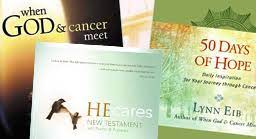
Adapted from 50 Days of Hope, copyright 2012  by Lynn Eib
[1] 2 Corinthians 5:7, NIV
[2] 2 Corinthians 5:7 NLT
[3] Taken from a devotional published by the Outreach of Hope “God Keeps his Promises,” 2001.

Music video “Walk by Faith” by Jeremy Camp also available at https://www.youtube.com/watch?v=ygyOECYwd-4

SIX THINGS ALWAYS TO SAY TO GRIEVERS


Have you ever felt helpless knowing what to say when someone has experienced a deep loss? How do we convey sympathy without saying something irritating or even downright painful? (See last’s week’s blog “Six Things Never to Say to Grievers.”)

Here are my thoughts on SIX THINGS ALWAYS TO SAY TO GRIEVERS.

KONICA MINOLTA DIGITAL CAMERA

  1. I’m so sorry.
    It may not feel as if you’re saying much, but honestly, there are no words you can utter to take away grief. We comfort much better when we give up trying to say something to “fix” the sad situation–it can’t be done. Let your hug, your handshake, your tears and your kiss on the cheek convey that you are sharing in your friend’s sorrow. The best comforters simply feel another’s pain; they don’t try to explain it.
  2. Would it be helpful if I ____________?
    Fill in the blank with something practical: Brought a meal? Picked up your kids for a play date? Mowed your lawn? Got you some groceries? Helped you sort through paperwork? Took you out for coffee? Or whatever creative suggestion you can think of. And then pick a date to do it. Concrete offers with a definite timetable are much more valuable than “Let me know if you need anything.” Grievers feel overwhelmed and don’t want to call people to ask them for a favor.
    If you know your friend’s “love language” (http://5lovelanguages.com), you can choose a sympathy gift accordingly. When my physical-touch-friend’s father died, I gave her a gift certificate for a therapeutic massage. My gifts-friend got a big bouquet of wildflowers (after the funeral bouquets had died.) When my Dad passed away in 2011, my friend Karen knew my primary love language is quality time, so she invited me to “Pamper Lynn Day.” We spent the day getting manicures, browsing antique shops, eating Thai food and talking about parents. It was such an emotionally refreshing day, we created “Pamper Lynn and Karen Day” and this year celebrated our seventh annual event!
  1. A great memory I have of him/her is _____________.

Mourners want to talk about their loved one and hear others speak of ways he/she touched their life. I often wait a few weeks to send a sympathy card so I have plenty of time to write a meaningful note of memories. (And also because grievers are inundated with “sympathy” immediately after the death. Then everyone’s life goes back to normal, but the griever’s never will.) Don’t be afraid to say the deceased person’s name. Yes, it may bring tears to their eyes, but their fear a loved one will be forgotten is even sadder.


  1. Is there an especially difficult time of the day/week when I should pray for you?
    When I asked members of my Grief Prayer Support Group this question concerning the hardest time of day, their responses varied. Many said they dreaded too-quiet evenings without their spouse. Some hated mornings with no child to wake up for school. Still others trudged through Sunday afternoons because that was then they always visited their parent. One man in my group feared Friday afternoons at three because that’s when his wife passed away. Discover your grieving friend’s difficult time and promise to pray for them then—you could even text/message a timely reminder that you are praying or send a short prayer to them.
  1. If you want to attend a grief support group, I’ll help you find one and go with you.
    It’s hard to walk into a roomful of grievers, but so much easier with a friend by your side. Many churches hold 13-week Grief Share programs (www.griefshare.org). Stephen Ministries, funeral homes and hospice often offer grief care meetings. There is even support especially for those who have lost a child. I’ve compiled a list of grief care organizations and resources in the back of my book When God & Grief Meet http ://lynneib.com/index.php/my-books/#anchor5(If you live near Hanover, PA and have lost a loved one to cancer, you can attend a grief prayer support group through Dr. Marc Hirsh’s office.)
  1. I care…and I’m here.
    Your presence speaks much louder than your words. If at all possible, be present physically. If that is not possible, “show up” in phone calls, texts, cards, notes or whatever means you have for connecting. You can be the kind of friends Aaron and Hur were for Moses in Exodus 17.  Moses had to hold high the staff of God for Joshua and the Israelite army because whenever he lowered it, the enemy prevailed. But “Moses’ arms became so tired he could no longer hold them up. So Aaron and Hur found a stone for him to sit on. Then they stood on each side of Moses, holding up his hands.”

Grieving is exhausting work. Ask God to help you find a sitting “stone” for your mourning friend and then show you how to hold up his/her weary arms.

For the LORD comforts his people and will have compassion on his afflicted ones. Isaiah 49:3

If the music video doesn’t automatically open, view in your browser or use this link https://www.youtube.com/watch?v=qEz2PsLJ-RI

SIX THINGS NEVER TO SAY TO GRIEVERS


If you want to start a lively discussion sometime, just ask a roomful of grievers whether anyone has made an insensitive remark to them since their loved ones died. I guarantee you the recollections will be vivid, free-flowing and still hurtful no matter how much time has passed.

We all encounter grieving people and of course, we want to offer our sympathy. (If you haven’t ever experienced a deep grief, I especially recommend listening to the song at the blog’s end, “I Will Not Say Goodbye” written by contemporary Christian artist Danny Gokey after the death of his 27-year-old wife.)

Here’s my list of SIX THINGS NEVER TO SAY TO GRIEVERS:

  1.  God must have needed him/her more than you do.
    God is self-sufficient and needs nothing. He is not made greater, stronger or better by anyone or anything. Yes, He loves our loved ones even more than we do, but He does not take them Home out of His own necessity.

2.   At least you have other children.
I remember when I miscarried our first baby at three months gestation on Mother’s Day of all days. That night a nurse came by my hospital room and told me: “You’re young—you’ll have other children.”

Her words did not comfort me. I didn’t want a “replacement” baby—I wanted that child I already loved. I needed to grieve the baby I would hold only in my heart and never in my arms.

And as devastating as a miscarriage can be, the death of a child is even more so.  A parent burying a son or daughter is so unnatural, I believe this is the deepest grief to bear. And having other children still alive does not diminish the loss. The less said by onlookers, the better.

3.    At least he lived a long life.

If this thought gives you comfort when your loved one passes, by all means say it to yourself, but it’s not a phrase that others should use with grievers. Simply because someone was 80, 90 or even 100 doesn’t mean it feels OK that he/she is no longer in this world. In fact, when a loved one has been in our life for a long time, it can feel really difficult not to see/call/take care of them each day.

My Mom passed away at the age of 82 after many health struggles and I mistakenly thought that because she had been in my life for a whole 60 years, I wouldn’t grieve as much. It has been four years and I honestly still could cry everyday—and many days I do.

4.    You’re young—you’ll find someone else.

Even if this is true, such a statement minimizes the special love relationship two people had. Those burying a spouse/partner/fiancé do not need to run out and find a new mate. They may indeed find love again, but first need to grieve what they had and lost.

5.    I know just how you feel.

I remember when someone said this to me shortly after my 86-year-old father passed away. I wanted to reply: “Really…your Dad died a few hours before your Mom got home from the hospital after being there two weeks for cancer surgery complications? So the day that was supposed to be your parents’ happy reunion became the date your brother had to drive three hours and break the news to your Mom? And meanwhile you were hurriedly driving seven hours in a vain attempt to say goodbye to your Dad? Really…you had all that happen to you, too? Every grief has it’s own uniqueness, including how it affects those left behind. So while you may have an inkling, you do not know exactly how someone feels.

6.    I thought you’d be over this by now.

People do not get over grief. They get through it. There is no universal timetable for grieving and grief work is not a linear progression. “Getting over it” is what we do when a boyfriend breaks up with us or we lose a job or someone hurts our feelings. The idea of “getting over” our grief implies that we’re never going to miss that person or be sad again. It’s simply not true because when we love deeply, we grieve deeply.

Here’s the perfect prayer to lift to God for yourself if you’re grieving, or for your mourning friends and family:

            Lord, you know the hopes of the helpless.
      Surely you will hear their cries and comfort them.
                                                                                 Psalm 10:17

NEXT WEEK: SIX THINGS ALWAYS TO SAY TO GRIEVERS


If the music video below doesn’t appear, please open in your browser or use this link https://www.youtube.com/watch?v=GcrUKDx3m6g

Does Everything REALLY Happen for a Reason?


Everything happens for a reason.

 Has anyone said that to you since your or your loved one’s diagnosis? I’m wondering how it made you feel? I have to be honest and say that phrase usually annoys me. So if it’s your favorite phrase in life and you love to say it or have people say it to you often, you might want to skip this blog.

Well, because you’re still reading I have to believe it’s for a reason 🙂  and I’m praying God uses these words to give you hope today as we wonder together what’s the “reason” for serious/chronic illness–or any of life’s trials.

I’m not sure who should get the original credit for that phrase: “Everything happens for a reason.” I’ve seen it attributed to Marilyn Monroe and Oprah Winfrey and I’m sure many other famous and not-so-famous people have spoken it often. I remember using it myself when I was a new Christ-follower back in college (at THE Ohio State University) and someone stole my wallet right out of my purse in the checkout line at the campus bookstore. I was terribly distraught and remarked to my friend Vince: “I know everything happens for a reason, but I can’t figure out what God is trying to teach me through this.”

I’ll always remember Vince’s reply: “I’ll tell you the reason this happened—someone sinned and stole your wallet!”

I liked that explanation. I quit agonizing over some spiritual lesson God was trying to teach me. Oh, I definitely learned things from the incident—like closing up my purse faster and trusting God for the money I’d lost—but I stopped imagining that every single thing that happened to me throughout the day was orchestrated by God for a divine reason that I had to figure out.

The phrase “everything happens for a reason” probably has multiple meanings to the many folks who utter it. But the word “reason” by definition means there is an explanation, a justification or rational grounds for what’s occurring. What’s implied is there is a good reason behind every single thing that occurs. I’m just not sure that fits life here on earth.


What’s the explanation for babies with cancer?

            What’s the justification for a married couple both having serious health issues at the same time?

            What’s the rational grounds for a young parent dying?

I honestly never figured out the  medical reason I got colorectal cancer at the age of 36 despite having no known risk factors. But I do know that “reason” did not have the final say in my life.

Remember Joseph, the young man in the Old Testament with the “coat of many colors?” His jealous brothers sold him into slavery, but he became a powerful person in Pharaoh’s court and eventually saved their lives. When his brothers finally asked for forgiveness for their evil actions, Joseph replied: “You intended to harm me, but God intended it all for good.”

I don’t know why this trial has “intended” to harm you or your loved one, but I do know from Romans 8:28 God can “intend” it for good.

Please notice this is a conditional promise. The working-together-for-good only happens to people who “love God” and are “called according to his purpose.”

The very next verse explains what that means. It says God “chose them to become like his Son.” That’s our purpose in life: to become more like Jesus. Then and only then can we be assured that everything that happens to us—even bad things—will be used by God for good.

Whatever the “reason” a serious trial has intruded your life, here is my prayer for you today from Philippians 1:9-11— I pray that your love will overflow more and more, and that you will keep on growing in knowledge and understanding. For I want you to understand what really matters, so that you may live pure and blameless lives until the day of Christ’s return. May you always be filled with the fruit of your salvation—the righteous character of Jesus Christ—for this will bring much glory and praise to God. Amen

P.S. Thanks for reading this today—I do believe it happened for a good reason! 🙂
Copyright 2102 by Lynn Eib, 50 Days of Hope

If the music video doesn’t automatically load, try opening in your browser or click on this link https://www.youtube.com/watch?v=vSxocnIaN0A