By Chris Tiegreen “Our Bible is full of miracles. Sometimes, it feels as if our lives are not. The difference between the two can be disheartening, especially when a miracle is the only thing that can help us through a time of need. We pray to God and hope that He will answer, wondering where the miracles have gone. If we really listen, we will hear Him tell us to open our eyes. “God’s dramatic miracles are scattered throughout history, sometimes in clusters (as in Acts), and sometimes spread out over painfully long years. But even when we don’t see the drama, God is always doing miracles. He redeemed us, after all–that was a miracle in itself. And He continues to work in our lives. Sometimes we see His hand, and sometimes we don’t. But the fact that He is working, whether behind the scenes or in plain view, should always fill us with hope.
“One of our problems is that we often anticipate the ordinary from God. We pray with realistic expectations, hoping He will answer us with obvious answers. Our minds confine Him to the predictable, forgetting that He is able to do infinitely more than we can even imagine (Ephesians 3:20). We underestimate Him.
“When you pray, trust that God is working. He may be working behind the scenes, or radically changing hearts in the midst of our circumstances, or waiting for the plot to unfold a little further before He intervenes in a visible way. But the key to seeing God work is to expect Him to work, He is–and always has been–the God of miracles.”
You see a few friends there, enjoy a couple of good conversations, a little laughter, and some decent appetizers. The party’s all right, but you keep hoping it will get better. Give it another hour, and maybe it will. Suddenly, your friend says, “I need to take you home.”
Now?
You’re disappointed. Nobody wants to leave a party early—but you leave, and your friend drops you off at your house. As you approach the door, you’re feeling all alone and sorry for yourself. As you open the door and reach for the light switch, you sense someone’s there. Your heart’s in your throat. You flip on the light.
“Surprise!” Your house is full of smiling people, familiar faces.
It’s a party—for you. You smell your favorites—barbecued ribs and pecan pie right out of the oven.
The tables are full. It’s a feast.
You recognize the guests, people you haven’t seen for a long time. Then, one by one, the people you most enjoyed at the other party show up at your house, grinning. This turns out to be the real party. You realize that if you’d stayed longer at the other party, as you’d wanted, you wouldn’t be at the real party—you’d be away from it.
Christians faced with terminal illness or imminent death often feel they’re leaving the party before it’s over. They have to go home early. They’re disappointed, thinking of all they’ll miss when they leave. But the truth is, the real party is underway at home—precisely where they’re going. They’re not the ones missing the party; those of us left behind are. (Fortunately, if we know Jesus, we’ll get there eventually.)One by one, occasionally a few of us at a time, we’ll disappear from this world. Those we leave behind will grieve that their loved ones have left home. In reality, however, their believing loved ones aren’t leaving home, they’re going home. They’ll be home before us. We’ll be arriving at the party a little later. [1]
[1] Randy Alcorn, Heaven, (Carol Stream, Illinois: Tyndale House Publishers), 2004, 441-442.
Chris Tomlin “Home” music video can be viewed on your browser or with this link https://www.youtube.com/watch?v=twL3v5r8s6o
So if God works all things together for good, does that mean in our lifetime we will see that promise come true? Maybe…maybe not.
I consider myself extremely fortunate that God has allowed me to see firsthand how He has used my cancer diagnosis for good by giving me a worldwide ministry to cancer patients and their caregivers. However, I’m very aware that many others still are waiting to see that promise of Romans 8:28 come true.Our view from inside an earthly trial is limited and distorted. We often cannot see how what is happening could ever possibly be used as part of God’s good plan. And we must realize we may not actually get to see the “good” because it’s not coming until the distant future. We have to ACCEPT that we don’t have the big picture.
“Now we see things imperfectly, like puzzling reflections in a mirror, but then we will see everything with perfect clarity. All that I know now is partial and incomplete, but then I will know everything completely…” 1 Corinthians 13:12
But accepting that we don’t have the whole picture is not very comforting unless we also BELIEVE that a loving God does.
Some years ago our youngest daughter, Lindsey, who had just graduated from college (and as the daughter most like me, butted heads with me the most as a teenager), wrote me a Mother’s Day note that said in part: “I didn’t always agree or understand when you said ‘no’ to me, but I never doubted that you loved me.”
That’s what it means to trust. We choose never to doubt that God loves us even if we don’t always agree or understand when He answers “no” to our prayers.
However, just knowing these two truths—accepting we don’t have the whole picture and believing a loving God does—is still not enough. We have to CONTINUE to walk by faith and not by sight. Even if we’re not from Missouri, we humans tend to be “show me” people. We want to see first and then believe. I am an extremely skeptical person (which makes me a great newspaper reporter, but an annoying wife), and I always want the facts, the explanation, and the logic before I’ll agree with just about anything.
But the Word of God, my compass in life and especially in the storms, tells me that as believers we are different than others in this world because “we live by faith, not by sight.”[1] Or as another translation puts it, “That is why we live by believing and not by seeing.”[2]
I must constantly remind myself that I don’t need to see it all because God sees it all from the beginning of history to the end of time. As one writer explains: “Because we see only this sliver of time, we tend to view all of time through the same narrow and ill-fitting glasses. We forget that God is not bound by time. He exists outside of its minutes and millennia.”[3]
He and only He has the big picture. We move ahead not knowing for sure how–or when–it all will work out, but believing He does and will guide our way.
I don’t know how to say it any other way than we simply walk by faith. And if we don’t have the privilege of seeing in this lifetime how it all works for good, we can be encouraged that we are not alone. Read the list of faithful heroes in Hebrews 11 and don’t miss verse 13: “All these people died still believing what God had promised them. They did not receive what was promised, but they saw it all from a distance and welcomed it.”
Remember the ABCs of trials: Accept you don’t have the whole picture; Believe a loving God does; and Continue on by faith and not by sight.
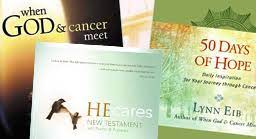
Adapted from 50 Days of Hope, copyright 2012 by Lynn Eib [1] 2 Corinthians 5:7, NIV [2] 2 Corinthians 5:7 NLT [3] Taken from a devotional published by the Outreach of Hope “God Keeps his Promises,” 2001.
Music video “Walk by Faith” by Jeremy Camp also available at https://www.youtube.com/watch?v=ygyOECYwd-4
The word “encourage” means to inspire or fill someone with courage, spirit or hope. But how in the world do you encourage someone who is depressed?
To answer that difficult question, I’d like to share some thoughts from the book New Light on Depression by David Biebel, D.Min. and Harold Koenig, M.D.
“Family members, loved ones, and friends should encourage depressed persons—to get up in the morning, to go out to dinner, to go to a movie, to exercise with them, to do the things their depression is preventing them from enjoying, and to seek professional help if they are not doing so already. Once depressed people get out and start moving they often feel a lot better. Encouraging, however is not the same as forcing, manipulating, or cajoling, nor will arguing about it help much…Here, again, discernment is crucial so that your suggestions are made in the right way at the right time, to ensure the greatest likelihood that they will be accepted.
“One way to encourage a depressed friend to get out (and to get help) is to find a good depression support group and invite your loved one to attend it with you.” [1]
Biebel and Koenig identify “four helping patterns” they have seen Christians employ with their depressed family and friends-only one of which really helps. These are:
Judging (“Your problem is caused by sin or lack of faith”)
Giving advice (“Cheer up—things could be worse!”),i
Identification (sympathizing so much that you get sucked into the pit of depression, too) and
Empathy (suffering together with the person).
According to the authors “Only empathy really helps.” [2] Empathizers deeply feel the other person’s pain, without making it their own.
“The empathizer goes and gets a ladder, puts it in the pit, and climbs down to be with the depressed person until he or she is ready to climb out,” the authors say. “The key difference is that the empathizer has a goal in mind—not just to feel the depressed person’s pain, but to also act in a sense as a redeemer, willing to pay whatever cost there is in order for the other person to be healed…
“If you are really going to help your loved one through and beyond depression, the only way is to lay aside your rights, by choice, with the goal of serving that person’s best interests until he or she emerges into the light of day again.” [3]
Got a ladder? Put it down in your depressed loved one’s pit, climb down with them and pray for them until they can climb out.
Save me, O God, for the floodwaters are up to my neck. Deeper and deeper I sink into the mire;I can’t find a foothold. I am in deep water, and the floods overwhelm me. I am exhausted from crying for help; my throat is parched. My eyes are swollen with weeping, waiting for my God to help me… Answer my prayers, O Lord, for your unfailing love is wonderful. Take care of me, for your mercy is so plentiful. Don’t hide from your servant; answer me quickly, for I am in deep trouble! Come and redeem me; free me from my enemies. Psalm 69:1-3, 16-18
O LORD my God, I cried to you for help, and you restored my health. Psalm 30:2
[1] David B. Biebel and Harold G. Koenig New Light on Depression: Help, Hope, and Answers for the Depressed and Those Who Love Them (Grand Rapids, Michigan: Zondervan Publishing House), 2004, 233. [2] Ibid, 246. [3] Ibid, 248-249.
If the music video doesn’t automatically load, open in your browser or click here https://www.youtube.com/watch?v=R0PCblOjOxg
I was in sunny Colorado (hence the glow on our faces!) visiting Gigi, my friend of 40 years, when all the hoopla broke over “Laurel or Yanny.” After we finally stopped talking and playing Boggle long enough to listen, I was shocked Gigi heard “Yanny,” as I would have bet my firstborn that the word was “Laurel” (sorry, Danielle). If you’ve been living under a rock, here’s the recording http://time.com/5278817/yanny-or-laurel-audio-clip-debate/
I’m the kind of skeptical person who likes to depend on my own five senses, but debates like this one (and the white/gold or blue/black dress uproar in 2015 https://www.nytimes.com/2015/02/28/business/a-simple-question-about-a-dress-and-the-world-weighs-in.html) remind me that we can’t always trust what we see or hear as the final word. In fact most of this world is invisible to us, and yet crucial for life and many medical treatments.
The only portion of the electromagnet spectrum that the human eye can detect is visible light, but we sure depend on the rest of those electromagnetic waves to get us through the day. Very long radio waves allow us not only to listen to the radio, but also watch TV, utilize the microwave, and call or text on our cell phones. And at the other end of the spectrum, short X-rays give us useful information about our health, and even shorter gamma rays make possible specialized radiation treatment for brain tumors.
And much of the world is inaudible, too. We all know the human ear only can hear a portion of sounds—those in the 2-20 kilohertz range. Dogs can hear much higher frequencies (up to 60KHz,) as can cats, who always pretend they can’t. But did you know most people can expect age-related hearing loss called “presbycusis?” That new vocabulary word explains why my seven-years-older-than-I-am-husband can’t ever seem to hear me.
And although Ralph’s hearing is not as acute as mine, he always has had a superior sense of smell. But his keen nose is nothing compared to a dog’s super-smelling abilities—about 300 million nasal sensors, six times more than a human. Canines already are used by law enforcement agencies to search for bombs and illegal drugs, but medical researchers are studying whether man’s best friend can “sniff” out cancer, too.
A 2016 CNN report described a dog named Lucy, who was kicked out of guide dog school because she was too distracted by odors. So her owners decided to take advantage of her sniffing prowess and train her to find malignancies instead. Apparently she can detect cancer’s unique odors and was reported to correctly sniff out cancer 95-percent of the time over a seven-year period. Clinical trials are continuing.
Other dogs have been described to accurately identify melanoma by sniffing moles and prostate cancer by taking a whiff of urine. (We already have CAT scans, why not DOG sniffs?)
Researchers also are checking to see if the volatile organic compounds found in our breath can be used to detect breast and lung cancer at early stages. Imagine taking a breathalyzer notto see if you’re too impaired to drive, but to find out if you have a malignant tumor.
And if you really want to blow your mind about the invisibility of our world, check out all the scientists who say what we can see is only a fraction of the whole universe.
I’ve read differing percentages, but most say the stars, planets and galaxies that can be seen make up only 2- to 4-percent of the universe. The remaining 96- to 98- percent can’t be seen, detected or even comprehended by astronomers!
I would never be confused with a quantum physicist, but I have known for decades that what is visible in this world is notthe sum of reality. I believe Plato knew it centuries ago when he asserted “the visible is a shadow cast by the invisible.” And the Rev. Dr. Martin Luther King Jr. echoed the Greek philosopher’s view in the 20thcentury when he wrote: “Everything we see is a shadow cast by that which we do not see.”
Romans 1:20 “For ever since the world was created, people have seen the earth and sky.
Through everything God made, they can clearly see his invisible qualities
—his eternal power and divine nature. So they have no excuse for not knowing God.”
This world is a shadow of the eternal power and divine nature of God. No matter how this world actually evolved, it started with a Creator and it will end one day with Him, too.
Don’t fix your eyes on what is seen. Don’t fix them on pathology reports or CT scans or blood work or insurance bills or statistics or anything else you can see. No matter what this life brings, fix your eyes on what is unseen. Then you will find peace…whatever you face.
Adapted from Peace in the Face of Cancer, copyright 2017 by Lynn Eib.
If the music video below doesn’t automatically load, click here https://www.youtube.com/watch?v=nO4uIyz_d90
Get a free gift when you sign up for my inspirational blog posts delivered directly to your email every other Wednesday.
About Me
I’m a newspaper reporter-turned-author. And I’m a passionate encourager, but always a truth-teller. I worked for nearly two decades in a unique position as a patient advocate in my oncologist’s office and the Cancer Prayer Support Group I founded in 1991 is the country’s oldest such faith-based group.
Since my diagnosis in 1990 of locally advanced colon cancer, I’ve offered hope to hundreds of thousands of cancer patients and their caregivers. I pray you will find encouragement here, too!

 “God’s dramatic miracles are scattered throughout history, sometimes in clusters (as in Acts), and sometimes spread out over painfully long years. But even when we don’t see the drama, God is always doing miracles. He redeemed us, after all–that was a miracle in itself. And He continues to work in our lives. Sometimes we see His hand, and sometimes we don’t. But the fact that He is working, whether behind the scenes or in plain view, should always fill us with hope.


 I’m a newspaper reporter-turned-author. And I’m a passionate encourager, but always a truth-teller. I worked for nearly two decades in a unique position as a patient advocate in my oncologist’s office and the Cancer Prayer Support Group I founded in 1991 is the country’s oldest such faith-based group.