Category: courage

Ouch! That really hurts!

As I watch the occupational therapist move along the table working on the hands of all of us seated there, I can’t help but be confused by the different ways he handles our injured extremities.

Seated next to me is a young woman less than half my age with a scar on top of her left hand instead of underneath like mine. Mike grasps her hand and begins bending and unbending her fingers. She quickly starts fidgeting in her chair as an anguished expression appears. Soon she obviously is writhing in  pain. I can’t see her toes, but I’m willing to bet they are curling in her sneakers. She never cries out, but I can’t bear to watch. Mike chats away about anything except her hand, seemingly ignoring the obvious agony he’s causing.

Mercifully after a few minutes of manipulation, he stops and the young woman’s face relaxes. Mike slides his stool until he is across the table from me. He grasps my left hand in his, but surprisingly does not inflict pain. Instead, he slowly and carefully moves it. At one point his motion does hurt and as I flinch, he immediately stops and apologizes.

So what gives? Does Mike like me more than the young woman next to me?  Why do I I seem to have it “easier”than the others? And is she wondering why her treatment is so much more difficult than mine?

I’ll answer those questions in a moment, but let me first ask you: Have you ever looked around at others and wondered why they seem to have it “easier” than you do? Have you pondered why their prayers appear to be answered while you’re still waiting on a heavenly response? Have you entertained the thought that maybe God loves them more than He does you?

It is so hard to be in pain (physical or emotional) for weeks, months–maybe even years–and wonder why God doesn’t cut us a break. We look around and see so many whose trials are not nearly as distressing as ours and wonder if God truly cares.

Do you want to know why Mike, a certified hand specialist for more than three decades, treats the young woman and me so differently?

Because he knows what’s best for us.

He knows that this pretty, petite young lady is in law enforcement and needs to be able to effective use both her hands to protect herself and others. Mike is all too cognizant of her need to allow some pain now for a greater gain later.

Conversely, the injured nerve in my hand is not going to improve if it gets aggravated by too much force. It needs time to heal now in order to be more useful later.

Mike has studied hands for many, many years and he knows how best to bring healing to them. I don’t begin to understand the complexities of the human hand, but I trust that our therapist does.

Does a clay pot argue with its maker? Does the clay dispute with the one who shapes it, saying “Stop, you’re doing it wrong!” (Isaiah 45:9)

Dear friend, God knows you better than Mike knows hands. The Lord created you and knit together every fiber of your being. He knows how to bring the healing you need.  I don’t begin the understand all the trials you and I are facing, but I trust that our Father does.
+++++++++++++++++++++++++++++++++++++++++

Be sure to open this email in your browser to hear the music video below, “In the Hands of the Potter” by Casting Crowns.


Does God Ever Give Us More than We Can Handle?


I had to smile when I read this, considering the incredibly stressful months my husband and I recently have faced with one health crisis after another.

How about you? Does it feel as if God may have overestimated your ability to handle problems? Are you pretty sure that what you’re facing is too much?

Well, I agree.

In fact, I believe that the trials allowed into our lives often are more than we can bear on our own–things like serious illness, financial struggles, relationship conflicts or any other of life’s myriad disappointments .

I consider myself a strong person, but back in 1990 at 36 facing cancer and the fact that my possibility of dying was greater than my possibility of surviving was more than I could face. Worrying about whether my daughters would have to grow up without a mother was way more than I could bear. And fearing that my husband would bury another wife was absolutely more than I could endure.

“This is more than I can handle,” I remember telling God, trying not to sound too whiny.

“I know,” He answered. “But it’s not too much for Me.”

That was one of the most freeing things I learned through my cancer journey. It was all right that I sometimes had more than I could handle. That’s when I would see the Bible verse in Philippians 4:13 come true in my life: I can do all things through Christ who strengthens me.

I ­didn’t have to reach down inside myself and muster up some super strength. God supernaturally supplied it to me as I trusted in Him.

What a relief!

Even if my own resources were exhausted, God’s would never be.

My strength might be sapped, but He could still move mountains.

Everything could be changing around me, but He was always my Rock.

During those first early dark-days-after-cancer, I often thought of the shepherd boy David as he went into battle against the giant Goliath. Do you know what his battle cry was?  He was the youngest and smallest boy in his family. Goliath was more than nine feet tall. But David’s battle cry was, “I know God can, I know God can.” If you read 1 Samuel 17:47 you’ll hear his exact words: The battle is the Lord’s. That phrase appears many times throughout the Old Testament, and it was what I said to myself as I awoke on most post-diagnosis mornings.“I feel like a little shepherd with a slingshot facing a giant named Cancer, and it is more than I can handle,” I told the Lord. “But I am so glad it is not more than You can handle. The battle belongs to You, Lord. Fight for me and through me. Do what I cannot do on my own.”

And He did.

I love how the Apostle Paul describes a time in his life when he was faced with more than he could handle: We think you ought to know, dear brothers and sisters, about the trouble we went through in the province of Asia. We were crushed and overwhelmed beyond our ability to endure, and we thought we would never live through it. In fact, we expected to die. But as a result we stopped relying on ourselves and learned to rely on God, who raises the dead. 2 Corinthians 1:8-9.

What a great message: Stop relying on yourself and learn to rely on God. Your struggles and setbacks, your disappointments and dilemmas are never too much for Him to handle.

Please open the music video below in your browser: “We Will Not Be Shaken” by Brian Johnson.

Being Optimistic Doesn’t Always Make It Better


It’s often said that there are two kinds of people in life: optimists and pessimists. You probably think I’m going to tell you to be an optimist, but I’m not. And that’s because optimism will not always change the inevitable. Take the case of the optimist who fell out of the twelfth-story window. As he went by the fifth-story, he looked around, smiled and said to himself, “So far, so good!” 

I think the best attitude for someone facing cancer or any other serious illness is neither total optimism (without a doubt, I’m going to be cured) nor total pessimism (without a doubt I’m going to die), but realism (without a doubt I have a life-threatening illness and I may or may not get better, so I will plan for both).

When we insist we are going to be cured, we set ourselves up for a terrible defeat if it doesn’t happen. On the other hand, if we insist our situation is hopeless, we already are defeated before we start. I believe it’s best to be realistic and make plans to be financially, emotionally and spiritually ready to depart this life. That’s not giving up. It’s coming to grips with our own mortality, so we can really life fully without the fear of death.

There’s a difference between total optimism and a positive attitude. Total optimism says: “I’m absolutely, positively going to be cured.” A positive attitude says: “I hope and pray and even expect that I’m going to be cured–but even if I’m not, I will not be defeated.”

I’ve seen scores of people who refused to entertain that thought that they might not be cured because they wanted to remain totally optimistic. And when the healing didn’t come, they–and their loved ones–were devastated.  I also know scores of people whose situation was considered medically “hopeless,” but they continued to live life fully and some of them even went on to become cancer-free!

A totally optimistic attitude insists lemons have to get sweeter. A positive attitude adds some sweetener and makes lemonade out of the lemons.

So many things are out of our control when we or our loved ones are facing a serious illness. But we can control our attitude.

Author Chuck Swindoll has a wonderful description of the power of a positive attitude: “Words can never adequately convey the incredible impact of our attitude toward life. The longer I live the more convinced I am that life is 10 percent what happens to us and 90 percent how we respond to it. I believe the single most significant decision I can make on a day-to-day basis is my choice of attitude. It is more important that my past, my education, my bankroll, my successes or failures, fame or pain, what other people think of me or say about me, my circumstances, or my position. Attitude keeps me going or cripples my progress. It alone fuels my fire or assaults my hope. When my attitudes are right, there’s no barrier too high, no valley too deep, no dream too extreme, no challenge too great for me.” 

2 Corinthians 4:7-9 describes our troubled situations well: “We now have this light shining in our hearts, but we ourselves are like fragile clay jars containing this great treasure. This makes it clear that our great power is from God, not from ourselves. We are pressed on every side by troubles, but we are not crushed. We are perplexed, but not driven to despair.  We are hunted down, but never abandoned by God. We get knocked down, but we are not destroyed.”

Your heart needs to find the right attitude—a positive, realistic attitude because God will never abandon you.

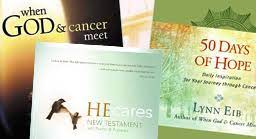
Copyright 2002 by Lynn Eib . Excerpted from When God & Cancer Meet, Tyndale House Publishers.

Let’s Stop Trying to Make All Our Pain Go Away


Guest blog by Brian Jones

Our goal as disciples of Jesus shouldn’t be to eliminate pain.

Our goal should be to craft the kind of life that is invincible to pain.

Those who learn how to be invincible to pain–“incapable of being conquered, overcome or subdued”–are an unstoppable force.

This is what Jesus meant when he said, “Whoever wants to be my disciple must deny themselves and take up their cross and follow me” (Matthew 16:24).

His challenge wasn’t to seek martyrdom – though that could certainly be part of the faith journey for a few – it was about being willing to endure pain as a disciple for his mission.

For disciples, being invincible to pain means they train themselves to view…

  • cancer as an opportunity
  • depression as a chance to view the world differently
  • work problems as openings to practice virtue
  • financial struggles as occasions to reassess what’s really important
  • relationship problems as a chance to learn something new

    Disciples allow nothing they face to deter them.

Instead of spending their days doing everything in their power to avoid all discomfort, they train themselves to no longer need comfort to function.

Think for a moment about how much of our lives is spent avoiding pain.

How much money have we spent on medications to drown out suffering?

How many vacations have we taken to distract us from our everyday problems?

Going to therapy to quickly stop a heartache instead of partnering with a therapist to teach us to sit with the pain a while and learn from it?

To be honest, I’ve wasted so much of my life trying to avoid pain that I have essentially earned a doctorate in pain avoidance. But that’s changing.

In my latest book Finding Favor: God’s Blessings Beyond Health, Wealth, and Happiness, I share that…“Between the ages of eighteen and forty-two, I could count on one hand the number of times I went to the doctor. But when I turned forty-three, for no apparent reason, I developed a severe neurological condition that triggered nonstop debilitating pain in the back-left base of my head. I went to three different specialists, and they were all baffled. Unable to find a cause, they put me on antiseizure medication.

Over the next five years, I underwent three surgeries, five MRIs, three CAT scans, and more ultrasounds and EKGs than I can remember. I had nine different rounds of medication administered via epidural injections in my back and neck. I lost most of the hearing in my left ear. I gained thirty pounds. I became depressed. I suffered extreme panic attacks. I went on an antidepressant. The pain became so severe that I could only sleep in forty-five-minute stretches before being jolted out of bed in pain.

My life verse throughout all of this was Job 13:15: “Though he slay me, yet I will hope in him.”

The turning point for me came when I realized that the Bible teaches that pain can be a blessing.

Pain is to be embraced.

Lessons are to be teased out of these experiences. They come to us to instruct in the way of Jesus.

Suffering makes disciples better, not worse.

One morning I woke up and simply said, “I am completely healed” and began thanking Jesus for what I was going through. Within one year, many of my symptoms disappeared. Those that didn’t have stayed on as my personal trainer in being invincible to pain. What I was truly healed of was my need for comfort above my need for Jesus.

Think about it: if pain can’t stop you, what does the enemy have left to throw at you?

You’re unstoppable.

NEXT WEEK:  PART II: “How to Train Yourself to be Invincible to Pain”


Brian is the founding Pastor of Christ’s Church of the Valley in Royersford, PA, a graduate of Princeton Theological Seminary, and the author of four books. He’s also my pastor and most important of all, a huge Buckeye fan! Connect with him at  https://brianjones.com


How to Find Joy in Trials


May 8, 1977.

Mother’s Day.

The day before I had been excitedly opening” mother-to-be” cards and looking longingly at the maternity clothes I would soon need to wear.

Now I was lying in  a hospital bed with an empty womb.

Really, Lord? A miscarriage on Mother’s Day? This would be awful on any day, but having it happen today seems especially cruel.  Why, Lord?

Nurses came in and out of my room doling out attempts at consolation.

“You’re young–you’ll have other children!” appeared to be the favorite sentiment.

They all seemed to have missed the point that I already loved this baby, whom I would only hold in my heart and never in my arms.

I desperately wanted some encouragement so I did something I never did before. I just randomly opened up my Bible and began reading the first verse my eyes gazed upon.

James1:2: “Consider it all joy, my brethren, when you encounter various trials,”

I thought about opening to another page, but instead kept reading: “knowing that the testing of your faith produces endurance. And let endurance have its perfect result, so that you may be perfect and complete, lacking in nothing.”

Really, Lord? You want me to find joy in the midst of this trial? I had a lot more joy before this trial came along! This hurts so much. This doesn’t sound all that comforting.

I don’t really get it, but Ok,  I will believe your Word. I will consider this trial a joy–not because of what has happened. But because of what will happen–how You will grow my faith through it.

I was sobbing as I uttered those painful words of surrender, just as I have every time since  in the forty-plus years whenever my faith has been tested.

Bestselling author Chris Tiegreen says that testing is the “only way for our faith to get from its raw state to refined beauty.”

“Like a precious metal in a crucible, the impurities must be burned with fire,” Tiegreen explains. “It’s a painful process…(but) once circumstances, trials, the enemy’s lies, and our own doubts are through assaulting it. whatever remains is precious and pure.”

No pain, no gain isn’t true of everything in life, but it does apply to our faith.  That’s why we need to endure…so the pain of refining can produce the gain of greater faith.

Joy is never my immediate reaction when a new trial comes along–like breaking my wrist and only being able to type with two fingers instead of my usual four! However, I have learned to trust God’s refining process. As Tiegreen says, “(trials) fit us for the Kingdom. They purify our faith and make it powerfully effective.”

And in that I can find joy.
++++++++++++++++++++++++++++++++++++++++++

To listen to the music video “Refiner’s Fire” open in your browser or click on this link https://www.youtube.com/watch?v=aSIazjrA0Ls