
Category: anger

How Anger Evolved into Peace

The early days of the pandemic were pretty tough on everybody, especially those–like my friend Erin–dealing with serious health issues.

“After months of doctors dismissing my symptoms, they worsened in April 2020,” recalls Erin, who was 42 and experiencing abdominal pain with occasional fevers. “I had a few Zoom visits–because of COVID, I couldn’t get anyone to see me. They kept saying the symptoms were from COVID, which I didn’t think they were, but no one would listen.”

Finally on Aug. 21, 2020–her 43rd birthday–surgery was scheduled at Johns Hopkins, near her Maryland home.  CT scans had revealed an infection and doctors expected to treat a diverticulitis abscess.

“But I woke up from surgery to hear they found a tumor in my sigmoid colon and a hysterectomy was needed because of widespread infection inflammation,” Erin says. “I was a very healthy woman who had taken good care of myself, but I became a crumbled, devastated mess.”

Erin, a wife and mother of three–aged 10, 13, and 15 at the time– says she was “terrified” when she heard the news, including the fact cancer had spread to three lymph nodes and she would need six months of weekly chemo.

Erin’s family 2020

“Everything was spiraling out of control and it all felt very unfair.”

Having a life-threatening illness was especially traumatic because her only sibling–younger brother Dominic–died in 2004 from a drug overdose at age 23.

“I was worried about my kids, my husband and my parents,” she explains. “I’ve already lost my brother; they’ve already lost their son. Hasn’t our family had enough tragedy?”

Erin and my paths first crossed in November 2020 when she messaged me on Facebook, thanking me for how helpful 50 Days of Hope had been. Shortly after that, she joined my Moms’ Cancer Prayer Support Group  on Zoom and garnered a bit of relief for the isolation she felt.

However, chemo was tough for Erin–her fingers peeled so much she couldn’t open her cell phone by touch, and she lost all her hair–despite the nurses’ assurance that never happened with her treatment regimen!

Then 22 months after her diagnosis, a blood test revealed abnormalities. Follow-up scans showed an 8mm (pea-size) tumor on her liver.

Erin, a businesswoman https://www.erinpelicano.com with an engineering degree, found the new diagnosis “more devastating” than the first one.

“I have a brain for numbers and everything added up to stage 4 disease that I probably  wouldn’t survive,” she recalls.

In July 2022 she had surgery to remove the small spot, followed by complementary treatments intended to boost her immune system.

When I asked her how this roller coaster ride has affected her spiritual faith, she says it has “evolved.”

“At first I was incredibly angry with God because we had lost my brother and I had tried to be a good person and do the right thing. And I kept looking for someone to give me the reassurance that I was going to be alright, but no one would.

“Eventually I realized I had to lean on God and prayer to provide me peace in my day,” she explains. “I didn’t want to die young, but I came to a sense of peace after so much anger.”

And that peace came even before she sent me this text last month.
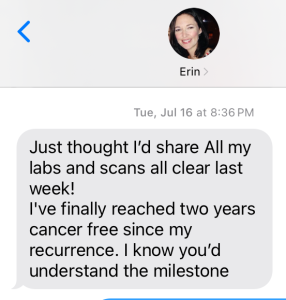
Erin says she continues to encourage others not to ignore their symptoms because “you know your body.”

“I knew something wasn’t right, but I couldn’t get doctors to listen to me. I think God can speak through our instincts,” she adds. “Don’t doubt yourself–fight for answers!”

Erin is committed to hearing truth everyday, so at 10 AM her favorite Bible verse pops up on her cell with some very wise words for the weary:

++++++++++++++++++++++++++++++++++++++++++
Open in your browser to hear “In the Valley” by CityAlight and featuring Sandra McCracken.

Restoring What the Locusts Have Eaten

This is the story of one woman’s pain, her mistakes, and her grief. But it’s especially the story of how God redeemed her heartaches…and her soul.

My dear friend Carmen grew up with an angry, abusive father, whom her mother divorced when Carmen was about 11 or 12. As she looks back on her rough childhood, she believes she suffered from undiagnosed clinical depression from her teens through early adulthood.

“I remember being tired, bored, lonely, and feeling nothing really made me happy,” she recalls.

Eventually she met a handsome star athlete as she was moving into her dorm at Temple University in Philly. They quickly were in a “serious dating relationship,” but before long, he “cheated” on her.

“My depression became worse and I internalized all the hurt,” Carmen says. “I thought the only way out of the pain was to end my life.

“That was the first attempt to take my life and then I compounded the problem by marrying him,” she acknowledges.

The second suicide attempt came after her new husband continued to stray.

“I tried to end my life again, but God wouldn’t have it,” Carmen remembers. “Even then, God had a bigger purpose for my life.”

The infidelity pain was compounded by two tragedies: Before the couple married in 1985, a baby boy born without kidneys who survived a mere 16 hours; then another son born in 1986 with multiple birth defects, who lived only 16 months.

Carmen was devastated.

Renea & Carmen

“I was so angry with God I went to see my friend Renea, who talked about knowing God–and I wanted some answers!,” she recalls. “I always thought she was the best friend and that she would be a really great friend if she’s just quit talking about Jesus!”

But when Carmen took her angry questions to her friend, “she gently and kindly told me about Jesus–a real Savior who wanted a relationship with me.”

The two women, friends since teenagers, started going to worship together, and Carmen still remembers the pastor’s sermon which changed her life. It was the story in 2 Chronicles 20 where the Israelites prayed and “raised a hallelujah,” and God made a way where there seemed to be no way.

“For the first time, the Word of God actually made sense to me,” Carmen says. “I went down front (of the sanctuary) and gave my life to the Lord on January 31, 1988.”

“Since then it has been a beautiful adventure,” she says, “I was miraculously healed of the depression and when my husband cheated on me again, I didn’t blame myself because I knew I was a child of God!

“I looked up and said ‘I deserve better than this!’ and that gave me the strength to leave him.”


Fast-forward to August 1997 when a co-worker introduced Carmen to his friend Greg. It was another whirlwind romance, but Carmen was not the same person.

“My criteria was a husband who loved God even more than he loved me, and I found one,” she explains.

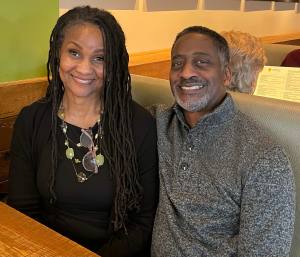
Carmen’s recent 60th birthday party

The couple married in March 1998 and have since adopted two children, son Quinn (now 16) from Ethiopia and daughter Makenzie (now 11) born in the States.

“God has restored everything that was taken from me,” Carmen says. “He completely healed my broken heart over my babies and He’s given me two beautiful children and a wonderful husband…this is a testimony of what God has done!”

No wonder one of Carmen’s favorite verses is Joel 2:25:

I will restore to you the years the locusts have eaten.

Carmen has been in my weekly women’s Bible study for almost four years and our group was shocked to learn of the heartaches she has faced, as she is known for her beautiful, glowing smile.

“It’s joy!,” she told us. “It’s not happiness; before I was seeking happiness and now I have JOY!

“I don’t share my story so you will feel sorry for me, but because I want you to know the miracle of God,” she explains. “I know God is real!”

As an adult, Carmen forgave and reconciled with her dad and they had many good years together before his death in 2005.

“He was just a flawed human being in need of forgiveness, just like the rest of us,” she explains. “And like my favorite song says: May my whole life prove that God is good.”

+++++++++++++++++++++++++++++++++++++++
Please open in your browser so you don’t miss Carmen’s favorite song, “God is Good” by Jonathan McReynolds. “The first time I heard it, I just broke down,” she says.

4 Things Not to Say to Suffering People

Two days after my cancer surgery in 1990 at the age of 36, a friend came into my hospital room  with a smile on her face as she announced: “God is going to teach you great things through this trial!”


I wanted to take the IV out of my arm, stab it in hers, and tell her to get in the bed and learn great things from God!

Instead, I smiled weakly and pushed the morphine pump button.

During my more than three decades of cancer support ministry I’ve known literally thousands of suffering people. Here are four things I’ve learned not to say:

1. You should…
However we might be tempted to finish that sentence, we need to stopSuffering people don’t need our advice unless they ask for it.  Suffering is overwhelming and becomes even more so when well-meaning people offer recommendations they believe will help. Most of us are “fixers” and can jump into that role as soon as we hear a need.

Chris Lawrence

Author and longtime stage 4 cancer survivor Chris Lawrence offers this insight: “There is something healing about another person affirming our situation–not just trying to ‘fix it,’ but instead being with us in it.”

Let’s affirm that we hear someone’s hurt. Offer a simple (non-preaching!) prayer. Give assurance of our love–and God’s–no matter what.

2. Something good/better will come from this.
Yes, God can turn mourning into dancing and trade ashes for beauty, but whatever good comes may pale in comparison to the losses and may not even happen in this lifetime.

My friend Marge whose immediate family–husband and two children–were killed by a drunk driver made this observation about suffering: “Grief has given me a perspective on life’s priorities, an appreciation of the significance of the moment, a delight in the distraction of the trivial and a fearlessness of death. But I would gladly give up all these insights to…have my family back.”

It’s not our job to make sense of someone else’s suffering. God may reveal that to them, but as He told Job, He doesn’t owe us an explanation.

3. You shouldn’t feel that way.
Saying this to a suffering person minimizes their pain and is like hitting them when they’re already down.

Remember Job’s friends? Before they started telling him what not to feel, they were great comforters.

When they saw Job from a distance, they scarcely recognized him. Wailing loudly, they tore their robes and threw dust into the air over their heads to show their grief. Then they sat on the ground with him for seven days and nights. No one said a word to Job, for they saw that his suffering was too great for words. Job 2:11-13

Let us, too, sit in silence in those moments when a suffering loved one needs a safe place to vent.

4. Everything happens for a reason.
If this is a favorite phrase and you love to say it to yourself, please, continue! But others may not find the sentiment comforting because the word “reason” by definition means there is an explanation, a justification or rational grounds for what’s occurring. The implication is there’s a hidden “good” reason something happened.

What’s the good reason for suicide? War? Murder? Molestation?

Instead of offering platitudes, let’s offer our presence. NY Times bestselling author Rick Warren shares this personal recollection:

Our small group came over after (our son) Matthew died. They said, ‘We’re spending the night at your house. We’re not going to leave you here alone. We’re going to be with you.’They didn’t try to give us any words of wisdom. They just gave us the ministry of presence. They slept on our couches and on the floor. I’ll never forget how it held us up.”

My friend was right–I have learned great things from God through my cancer journey.

I just wish she hadn’t told me while my suffering was still too great for words.

++++++++++++++++++++++++++++++++++++++
Open in a browser to hear “God of Comfort” by CH Worship.

Are you telling yourself the truth?

Do you remember the old game show “To Tell the Truth”?

My mother and I enjoyed watching that daytime show in the ’60s, but if you’re not familiar with it then or the later remakes, here’s the gist.

Three people introduce themselves as the same person–a real individual  who has an incredible story to tell. Of course, only one is telling the truth. Four celebrity panelists ask the contestants questions to try and determine whom they believe.

Sometimes my mom and I spotted the truth-teller, but other times we totally believed the convincing, but wrong person.

As a trained journalist, I like to think of myself as a diehard truth-teller. But while my writing facts are accurate, I know some of the things I tell myself (and believe) are not truth-filled. Especially when I’m physically tired and emotionally overwhelmed, my self-talk can sink into lies or at least half-truths. (I don’t know about you, but those old, discouraging “tapes” in my brain can really take over!)

Christian psychologist, the late Dr. William Backus defines self-talk as “the words we tell ourselves about people, self, experiences, life in general, God, the future, the past…all the words you say to yourself all the time.

Dr. Backus further explains that “In emotional and mental health, what you believe is all important…Other people, circumstances, events and material things are not what make you happy. What you believe about these things is what makes you happy or unhappy.”

That’s why if you don’t want to be fooled by untruths, Dr.Backus says you need to do three things:

  1. Locate your misbeliefs
  2. Remove them.
  3. Replace the misbeliefs with truth.

Here are just a few truths Dr. Backus recommends we tell ourselves:

  • Even if the thing I’m worrying about happens, I can face it without falling apart because God’s Word says my strength is made perfect in weakness.
  • I am not responsible for providing the solutions to everyone’s problems because others can minister as well.
  • God has created me as an emotional being so I can expect to have emotions. But God also has given me the fruit of the Spirit: self-control. I will control my feelings so they can’t control me.

Jesus explained the real source of lies is Satan himself: “He has always hated the truth because there is no truth in him. When he lies, it is consistent with his character; for he is a liar and the father of lies.”

In contrast, one of the phrases Jesus often spoke was “I tell you the truth” or “Verily, verily” as the KJV translates it. He is the ultimate truth-teller and can be trusted.

Does anyone want to live a life that is long and prosperous?
Then keep your tongue from speaking evil and your lips from telling lies. –Psalm 34:12-13

The psalmist might have been thinking about not lying to others, but I believe that spiritual truth applies also to what we tell ourselves.

So what are you facing that needs some truth-telling?  Illness? A chronic health condition?  Divorce? Financial struggles? A wayward child? Grief? Loneliness?

Whatever it is, dear friend, please tell yourself and believe this truth from Dr. Backus: “My circumstances don’t have to be pleasant or happy because my joy comes from my relationship with God and His unchanging faithfulness.”

And now, dear brothers and sisters, one final thing. Fix your thoughts on what is true, and honorable, and right, and pure, and lovely, and admirable. Think about things that are excellent and worthy of praise…Then the God of peace will be with you. –Philippians 4:8-9

NEXT BLOG: THE HEALING POWER OF A CHRISTIAN MIND
++++++++++++++++++++++++++++++++++++
Open in your browser to hear the powerful song “Voice of Truth”  © 2003 by Casting Crowns. 

Heard any insensitive remarks lately?


“Oh, my grandmother had that kind of cancer—she didn’t last long.”

“My neighbor has what you have—he’s in so much pain.”

“I thought you’d be over this grieving by now.”

Heard any such insensitive (dare I say “stupid”) remarks?  I think I’ve heard them all and then some.

I remember bumping into a church friend at the grocery store shortly after I my cancer diagnosis in 1990. She apologized for not being in touch with me.

“I thought I heard you were going to die. I didn’t know if that was true, so I just didn’t know what to do,” she quickly spit out.

She kept babbling for a while, and I remember I ended up trying to comfort her in the fresh vegetable aisle.

Ken ready for the annual Ride For Roswell Cancer Center fundraiser.

I think relatives, friends, and acquaintances are usually at a loss for words when they hear about someone’s diagnosis or recurrence, so they say something to either a.) try to identify with the person or b.) try to lift their spirits. Often they succeed with neither, especially when they immediately begin spouting Bible verses.

Someone started quoting scripture to my western New York friend Ken just moments after he was given the devastating news of tongue cancer requiring life-altering surgery, radiation, and chemotherapy.

“I only heard the first few words and wanted to scream at my friend, ‘Stop! Just stop!’” Ken still recalls 19 cancer-free years later.

First Lady Eleanor Roosevelt

I’m willing to bet you can remember some not-very-helpful comments made to you or your loved one. How do we handle such insensitivity?

I like the advice attributed to first lady Eleanor Roosevelt: “To handle yourself, use your head; to handle others, use your heart.”

Do you think my friend at the grocery store saw me standing by the romaine lettuce and thought, “I’ll walk over to Lynn and say something that will make her feel really bad?”

Of course not. I’m sure her heart was feeling love for me and concern over my well-being, however poorly she expressed it. And the same was surely true for Ken’s Bible-quoting friend.

Think about the last  life-struggle conversation you had with someone that left you feeling worse instead of better. Ask yourself whether you think that was the person’s intention. If yes, I recommend you speak with someone who can help you establish healthy boundaries with a spiteful person!

But if you answered no, then ignore that person’s words and just hear his or her heart for you.

Photo by Humphrey Muleba on Unsplash

We always want people to give us the benefit of the doubt or cut us some slack, but we have to admit, it’s not always easy to do the same for others—especially when our world has been rocked by a life-altering event. Our emotions are fragile, our bodies are hurting, and our spirits can be wounded easily. That makes it hard to be patient with well-meaning but insensitive folks.

So if you want to find peace in the face of life’s difficulties, use your head to handle yourself and your heart to handle others. And most of all, keep both your heart and mind open to receive the Lord’s perfect peace.

I am leaving you with a gift—peace of mind and heart.
And the peace I give is a gift the world cannot give.
So don’t be troubled or afraid
. –Jesus speaking in John 14:27

+++++++++++++++++++++++++++++++++++++++++++++++++
Be sure to open in your browser to hear the music video “Perfect Peace” by Laura Story