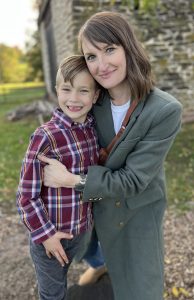
 On a recent, dark, foggy morning, my husband and I were riding in the car with our youngest grandchild. As we drove past the nearby Limerick nuclear power plant and its steamy twin towers, 6-year-old Mathis made this observation:
“Those cloud-maker buildings are really working hard today…I can’t even see the sun!”
I had to smile at his description of “cloud-maker buildings” hiding the light.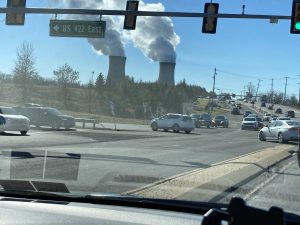
Do you ever feel as if some “cloud-maker buildings are really working hard” to darken your days?
I recall an awful time in 2017 when all of my normal “support team” was either knocked out of commission or otherwise occupied:
- My youngest daughter’s 2-year-old had the flu, her 6-month-old had a double ear infection while her husband and 4-year-old were recovering from the flu.
- My middle daughter was tending to her two preschoolers, both with the flu, following her own (and her kindergartener’s) bouts with it.
- One of my oldest daughter’s best friends was run over by a car while jogging and in trauma care fighting for her life.
- My prayer partner of many years had a hacking cough from the flu and couldn’t even talk on the phone.
- My closest friend from church was unreachable in another country.
- My poor husband still was having trouble with his knee replacement and couldn’t walk or drive without severe pain.
- And while working on our 2016 taxes—much too late—I discovered a clerical error with a tax bill resulting in several thousand dollars of unpaid taxes, penalty fees galore, and a possible lien on our home.
As I stressed over deadlines for FB book launch posts, blogs, magazine articles, and speaking engagements, as well as concern for so many loved ones in dire straits, my heart was overwhelmed.
So I tried to be extra “good” to myself. I got a massage. I went for walks. I sat in my hot tub. I ate big bowls of popcorn. I drank a root beer float with the popcorn.
I prayed. I read my Bible. I listened to worship music.
But I still couldn’t “see” the Son.
Finally, I texted Gigi, my friend of many decades in Colorado, and asked her to call me that weekend.
Within moments, my phone beeped.
“You must be really desperate to want me to call,” she said with a laugh.
“I am!” I responded as the tears welled up.
And then I dumped it all on my dear friend. Everything I wrote about here with much more detail and weeping.
I’m not going to share exactly how Gigi responded, but she calmly and prayerfully led me into the presence of Jesus so that I could feel His love for me.
In those few moments absolutely nothing changed in my circumstances and yet everything changed inside me as Psalm 61: 2 came true before my eyes.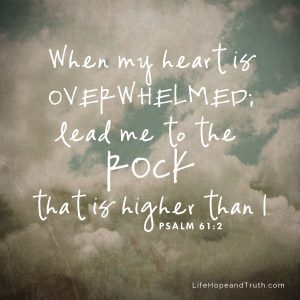 My friend’s prayer lifted my eyes off all the “cloud-maker buildings” and focused them on my Rock and my Redeemer who is above it all and could take the burdens I was never meant to carry.
You light a lamp for me. The LORD my God, light up my darkness. Psalm 18:28
Dear friend, I don’t know how or when God will lead you to the high rock, but I believe with all my heart that He will. Keep crying out to Him and when you can’t hear His voice, ask a trusted friend to cry out with you. He’ll take the burdens you never were meant to carry. +++
P.S. A few updates from the 2017 crises: My oldest daughter’s friend miraculously recovered from the accident. My husband’s knee was infected and had to have a second (and thankfully, successful) replacement. I got the taxes straightened out without going bankrupt. Gigi now lives across the street so I can just holler out the door when I need her! 🙂
++++++++++++++++++++++++++++++++++++++++++++
Please open in your browser to hear the incredible song, “Great Reward” by Tim Timmons, longtime stage 4 cancer survivor and my friend!
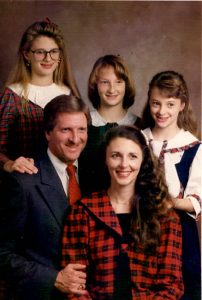 Two days after my cancer surgery in 1990 at the age of 36, a friend came into my hospital room with a smile on her face as she announced: “God is going to teach you great things through this trial!”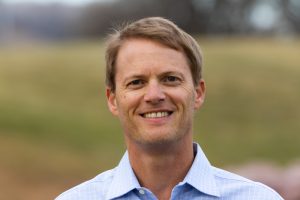


 So we walked to the far side of the store and down the last aisle. Near the end, Mom stopped at a big display of Ohio State paraphernalia.

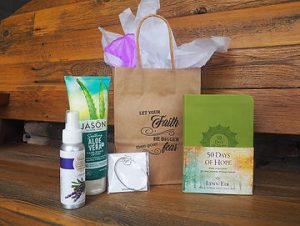
 At first, Kim hand stenciled “Let your Faith be Bigger than your Fear” on each bag, but eventually hired a supplier to do that job. However, she still personally packs and prays over each bag.
 I’m a newspaper reporter-turned-author. And I’m a passionate encourager, but always a truth-teller. I worked for nearly two decades in a unique position as a patient advocate in my oncologist’s office and the Cancer Prayer Support Group I founded in 1991 is the country’s oldest such faith-based group.