Category: fear

How Your Mind Can Help Heal Your Body

Isn’t it amazing the impact our thoughts can have on our bodies?

Back in 1990, I got chemo every Wednesday and that evening we would take our girls to Shoney’s Restaurant for supper because kids 12 and under (of which we had three!) were free. I was always pretty nauseous, so while my family enjoyed the buffet, I sipped a cup of cream of broccoli soup and ate saltines.

A couple weeks after I finished treatment, we decided to go to Shoney’s again. I was anticipating being able to enjoy the array of food, but guess what? The memory of all those stomach-churning weeks made me feel so nauseous I thought I was going to be sick just standing at the buffet! (And it took me years to be able to eat cream of broccoli soup again!)

Our oncology office had a teenage boy who used to come in for treatment and each time–before he even got a drop of chemo–he would puke. No amount of anti-nausea medicine ahead of time ever prevented it. And I also know a cancer survivor who got nauseous when she saw her oncologist at the mall! (Glad that wasn’t true for me because my oncologist and his wife became our best friends!)

Obviously, the connection between mind and body is real. But our mind’s influence on our body can be positive as well as negative. And while I don’t believe our thoughts can guarantee a better outcome for our health, I do believe they can influence it. Psychologist and author Dr. William Backus says people dealing with illness need to remember three facts:

Your beliefs create your thoughts.

Your thoughts generate feelings.

Your feelings affect your body’s healing systems.

“Psychoneuroimmunology” is the fancy label attached to the subject of mind-body healing, which is being studied increasingly by therapists and researchers, who even have discovered a hard-wire connection between the body’s immune system and the brain’s central nervous system.

So, if your brain has the ability to send messages to your immune system cells, “what you believe and tell yourself can become a powerful medication in your personal pharmacy,” according to Dr. Backus.

He advocates not just positive-thinking, but telling ourselves the truth about our situation. He has gathered many examples of truthful healing beliefs embraced by those who have survived life-threatening illnesses. Here are a few—I hope you, too, can add them to your mind’s pharmacy:

  • “I refuse to believe my diagnosis is an automatic death sentence.
  • I believe treatment is effective against this illness, especially the skillful efforts of scientific medicine combined with my strategies for replacing lying thoughts with the truth.
  • I believe my hormones and immune system were created to be on the side of my healing and can work to overcome this illness.
  • I believe God is on the side of my healing because His unbreakable Word says so.
  • I believe I am personally responsible for my treatment and for managing it.
  • I believe hope is a choice. I choose hope, not hopelessness.
  • I believe I’m on earth to share hope, and joy with others. I’m here to love others, regardless of my physical condition.
  • I believe that God’s will is good. I believe that He loves me and wants only the best for me—no matter what He is allowing me to experience right now.
  • I can recover from this illness and live a rich, productive life. But whether I recover or not, I am going to leave this life someday regardless. Until then I can live a full life of service every day for as long as I am given.” William Backus, The Healing Power of the Christian Mind (Minneapolis: Bethany House, a division of Baker Publishing Group, 1996) 96.

Don’t be impressed with your own wisdom. Instead, fear the LORD and turn away from evil. Then you will have healing for your body and strength for your bones. Proverbs 3:7-8

My child, pay attention to what I say. Listen carefully to my words. Don’t lost sight of them. Let them penetrate deep into your heart, for they bring life to those who find them, and healing to their whole body. Proverbs 4:20-22

If the music video doesn’t automatically load, open in your browser or use this link https://www.youtube.com/watch?v=Yzejd6r9DwE

The Most Beautiful Sight on My Riverboat Cruise


My husband and I recently returned from a breathtaking cruise of the Rhine River from Amsterdam, Netherlands through Germany and France to Basel, Switzerland.  We basked in the beauty of more than 7 million tulips blooming at Keukenhof Gardens, marveled at the 13th-century Gothic architecture of the Cologne Cathedral, 

 spotted 30+ medieval castles along the spectacular 80-mile river gorge,

and delighted in the brush strokes of such artistic giants as Rembrandt, Vermeer and Van Gogh,

while intermittently feasting on French pastries and warm German “apfelstrudel”with vanilla sauce. (#happyhusbandesserts)

But during our three days in Amsterdam and our week down the Rhine River, the most beautiful sight–which literally brought tears to my eyes– was not a wonder of nature nor a human masterpiece. It was the memory of a person.

Corrie Ten Boom.

If you’re already familiar with the Dutch woman known mainly from The Hiding Place book and movie, I don’t really have to explain why it was such a thrill to stand on the same floors she walked more than 70 years ago.  Tears filled my eyes as I stared into the actual hiding place where Jews and members of the Dutch resistance were safely tucked away from the Nazis (left photo).  Let me share a little of that story from the website for the Ten Boom Museum shown below:

During the Second World War, the Ten Boom home (above the family jewelry business) became a refuge, a hiding place, for fugitives and those hunted by the Nazis. By protecting these people, Casper and his daughters, Betsie and Corrie, risked their lives. This non-violent resistance against the Nazi-oppressors was the Ten Boom’s way of living out their Christian faith. 

During 1943 and into 1944, there were usually 5-6 people illegally living in the Ten Boom home: some of whom were Jews and others members of the Dutch underground. Additional refugees would stay with the Ten Booms for a few hours or a few days until another ‘safe house’ could be located for them.

Through these activities, the Ten Boom Family and their many friends and co-workers of ‘the BeJe group’ saved the lives of an estimated 800 Jews and other refugees.

On February 28, 1944, the Ten Boom Family was betrayed and the Sicherheitsdienst (Security Service) of the Nazis raided their home. That day, more than 30 people were arrested, among whom were father Casper and Betsie and Corrie, his two daughters that were living at home. Corrie’s brother Willem, sister Nollie and nephew Peter were at the house that day and were also taken to prison.

Although the Sicherheitsdienst arrested many visitors, they could not find who they were really after. Safely hidden behind a false wall in Corrie’s bedroom (entrance was through a removable bottom shelf) were two Jewish men, two Jewish women and two members of the Dutch underground. Although the house remained under guard by the Sicherheitsdienst, members of a local police resistance group were able, by cunnings means, to liberate the refugees from the ‘hiding place’ 47 hours later. The four Jews were taken to new ‘safe house’, and three survived the war. One of the underground workers was killed during the war years, but the other survived.  (The photo shows how narrow the hiding place was and wall stencils illustrate how six people stood inside for two days.)

Ten days after his arrest, father Casper died in Scheveningen Prison. Betsie and Corrie also spent some time in that same prison. From there, they were transported to camp Vucht and then to the notorious Ravensbrück Concentration Camp in Germany.

Life at Ravensbrück was almost unbearable, but Betsie and Corrie spent their time sharing Jesus’ love with their fellow prisoners. Many women became Christians in that terrible place becauce of Betsie and Corrie’s witness to them. Betsie died at Ravensbrück (age 59) but Corrie miraculously survived.

Corrie ten BoomAfter her release from Ravensbrück Concentration Camp (age 53) Corrie travelled all around the world to tell everyone that “there no pit so deep that God’s love is not deeper still” and that “God will give us the love to be able to forgive our enemies.” In more than 30 years, Corrie visited over 60 countries to testify to God’s love an to encourage people with the message that “Jesus is Victor.” On April 15th, 1983, on her 91st birthday, this remarkable woman died in Orange, California.

I cannot wait to meet this amazing woman in Heaven one day. I pray her story encourages you to believe that God’s love can reach into your or your loved one’s deep pit and to trust Him to be your safe hiding place.

You are my hiding place and my shield. I wait for your word. Psalm 119:114

For you are my hiding place; you protect me from trouble. You surround me with songs of victory. Psalm 32:7

He has hidden me in the shadow of His hand. Isaiah 49:2

(To read more about the Corrie Ten Boom Museum, go to https://www.corrietenboom.com/en/home. Her author page on Amazon.com lists her many books.)

(If the music video below doesn’t automatically load, click on https://www.youtube.com/watch?v=RzqpkMJxyss)


Helping Kids Cope with Cancer and Celebrating One Boy’s CURE


One of our church’s pastors, Matt, and his wife Carrie have been living in the shadow of cancer since December 2009, when their oldest child, Ian, was diagnosed with acute lymphocytic leukemia at the age of 3 ½ .

Matt vividly recalls the moment the doctor gave them the diagnosis. 

“Acute leukemia were not the words we expected to hear,” Matt says. “In my mind, I equated that (diagnosis) with death and I thought I was going to lose my son.”

Later that night after the frightened couple put Ian and younger brother Nathan, then 1 ½ , to bed they joined hands and “told God we fully gave Ian to Him,” Carrie recalls.

“We prayed for our marriage to be able to withstand the stress that was about to come upon us,” she adds.

Ian underwent six phases of aggressive chemotherapy over more than three years and was in and out of the hospital for treatment and its debilitating side effects.

I recently asked Carrie and Matt how they helped their young family, which now includes a daughter, Quinn, see God at work in the midst of this trial.

“We openly discussed our fears and when we felt alone and even distant from God,” Carrie explains. “We also served in our ‘cancer community’ by showing God’s love in practical ways to others who were suffering, too.”

A couple of years ago, Ian and his family loaded up their van to go out to eat and celebrate his third cancer-free anniversary. Carrie recalls:  “I noticed Ian sitting there with his eyes closed and hands folded. I wasn’t sure if he was praying, so I asked him if he was OK.”

“Yes,” was the young survivor’s reply. “I was just thanking God that I’m still cancer-free.”

On February 27, 2018–five years after Ian finished treatment– doctors officially pronounced the 11-year-old CURED! He and his extended family joyfully celebrated with a Disney cruise vacation.


Every year nearly 16,000 children in the U.S. are diagnosed with cancer and worldwide about a quarter of a million kids get that bad news. That’s a new child diagnosed with cancer every three minutes.

Statistics are not compiled for how many parents of minor children get cancer, but about 3.2 million of the U.S. adults diagnosed annually are ages 21-55 and therefore likely to still have kids at home. And that’s not even counting all of those cancer patients with young grandchildren.

However you add it up, there are a millions of families facing cancer with children.

So how can you best help the children in your life?  Fred Rogers has been quoted as saying: “Anyone who does anything to help a child in his life is a hero to me.”  So here are my recommendations written in an A- B-C style in honor of my hero, Mister Rogers:

  • Allow your feelings to be seen—even the sad ones. Obviously, it’s our job to help our children with their feelings, not vice versa, but if you want them to see how God is walking with you, you’ll need to share your struggles at times. It’s OK for children to know that sometimes we are afraid or angry or worried because then we can show them how a Christ-follower seeks God’s help with those feelings.
  • Be age-appropriately honest. Don’t tell all the statistics, but do use the word “cancer.” If you don’t, it may seem as if the word is too scary to even utter. It isn’t. Take away some of its supposed power by naming it as simply another illness. Sometimes when we don’t tell children the difficult truth, they imagine something even worse.
  • Create ways kids can give of themselves. Let them make cards or little gifts for the one facing cancer. Encourage them to pray specifically for that person every day. If the child is the one with cancer, follow Ian’s family’s lead and minister to others going through hard times. It’s so much easier to get our minds off our own troubles when we reach out to others.
  • Don’t make promises you can’t keep. We never told our girls “Mommy will be fine” because there was no such guarantee. We did promise them that the doctors would do everything they could to make me well, I would do everything to get well and that we expected I would become well.
  • Empower them by praying for them and with them—as in out loud and not just at mealtimes. Show them how to trust God even when we don’t like our situation. Don’t promise them that the one with cancer will be healed, but promise them that the One who created that person loves him/her with an everlasting love and will never leave them.

Facing cancer with children can be a wonderful first-hand lesson of the supernatural power of God in our lives. Help guide them to the path of peace as the Lord guides you there, too. The positive impact of this journey can be seen for generations to come.

Our children will serve Him;
future generations will hear the story of how the Lord rescued us.
They will tell the generations to come
of the righteousness of the Lord,
of what He has done. Psalm 22:30-31 The Voice Bible

Adapted from a chapter in Peace in the Face of Cancer, copyright 2017 by Lynn Eib.

(For parents with cancer, I recommend When a Parent Has Cancer: A Guide to Caring for Your Children by Dr. Wendy Harpham. For parents of children facing cancer, I recommend Chase Away Cancer: A Powerful Story of Finding Light in a Dark Diagnosis by Ellie Poole Ewoldt.)

If the music video doesn’t appear, use this link https://www.youtube.com/watch?v=Uy2EtG3UkL8


 “Do one thing every day that scares you.”

I love this quote attributed to Eleanor Roosevelt. I can only imagine how many “scary” things this American First Lady had to do each day. She was described as a shy child and was orphaned by age 10. Later her husband, Franklin D. Roosevelt, was stricken with polio, necessitating her expanded role in his political career. Eventually she became the first First Lady to speak out on political and humanitarian issues, for which she was both strongly criticized and enthusiastically praised. I wonder if she woke up each day reminding herself: Do one thing today that scares you.

That’s probably a good mantra for those facing serious trials and their caregivers—although some days you may have to do several things that scare you!

A post appearing online in recent years asserts that the phrase “Fear not” appears in the Bible exactly 365 times—one for each day of the year. The first time I saw that post, my natural reaction—as a reporter who needs two sources to verify anything—was to look it up and count them for myself.  I turned to BibleGateway.com and discovered the King James Version uses that phrase 64 times—exactly .1753424 times for each day of the year.

Okay, just because it’s not listed 365 times doesn’t mean it’s not good advice for every single day.  So what do we do with our understandably fearful reactions?

There’s a great story in the Bible which I believe offers some clues. It’s found in 2 Chronicles 20. The Jewish king Jehoshaphat was told that some great armies were coming to attack Jerusalem. His reaction was not atypical from what ours might be—he “was terrified” and then he “begged the Lord for guidance” (2 Chronicles 20:3). Shortly, God answered that prayer by sending His Spirit to speak through one of the king’s men:

He said, “Listen, all you people of Judah and Jerusalem! Listen, King Jehoshaphat! This is what the Lord says: Do not be afraid! Don’t be discouraged by this mighty army, for the battle is not yours, but God’s. Tomorrow, march out against them. You will find them coming up through the ascent of Ziz at the end of the valley that opens into the wilderness of Jeruel. But you will not even need to fight. Take your positions; then stand still and watch the Lord’s victory. He is with you, O people of Judah and Jerusalem. Do not be afraid or discouraged. Go out against them tomorrow, for the Lord is with you!” 2 Chronicles 20:15-17

The king and his people agreed to “fear not”—instead they believed God and began to worship Him, praise Him, and sing to Him. At the very moment they did this, the Bible says God caused the approaching armies to fight amongst themselves and kill each other. The Israelites won the battle without a fight because God fought for them.

Logically, standing still does not sound like a good way to win a battle. But then God’s ways are not our ways, are they? The armies coming against Jehoshaphat were way too large and powerful to be defeated by him. The situation was hopeless from his perspective—but it was hope-filled from God’s vantage point. All the king had to do was acknowledge his fear, pray to God and then stand still.

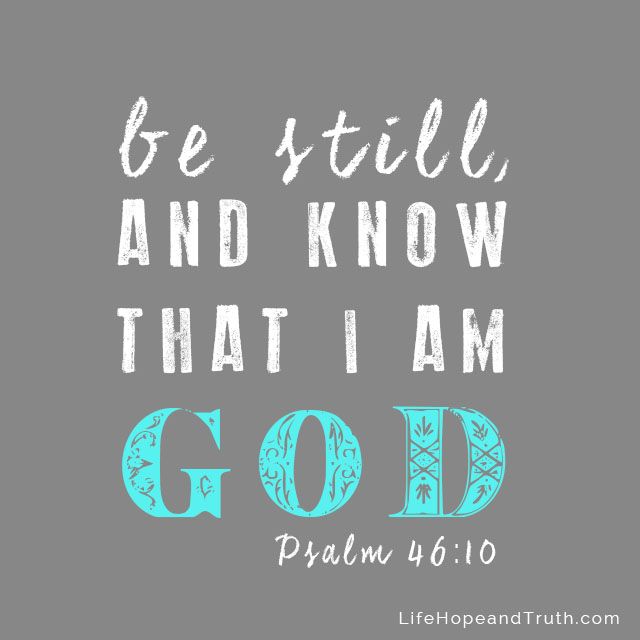
One of the most difficult admonitions in Scripture for me to follow is Psalm 46:10: “Be still and know that I am God.” 

The word translated still in Psalm 46:10 is the Hebrew word harpu. I’m no Hebrew scholar, but I did some research and found it conveys the idea of ceasing to act or letting go. It’s the opposite of striving with our arms up, ready to fight or at least defend ourselves.

I know that we talk about “battling” cancer or other illnesses, but I also think that at times we need to quit striving, acknowledge our fears, surrender the fight to God and release His power to work in our situation.

Perhaps the scariest thing God is calling you to do today is to “be still” and trust Him.

The LORD is for me, so I will have no fear. What can mere people do to me? Psalm 118:6 NLT

COURAGEOUS PEACE REPLACES fear when we are still and know He is God. (This post is excerpted and adapted from Peace in the Face of Cancer, copyright Lynn Eib 2017.)

[1] Although this quote is widely attributed to Eleanor Roosevelt, including in a 2013 book by the same name, I could not verify any original sources. The earliest verifiable print source with this phrase appears to be a June 1997 Chicago Tribune advice column by Mary Schmich. But even if Mrs. Roosevelt didn’t utter this sentiment, I think she lived it!

(If the music doesn’t load, please use this link https://www.youtube.com/watch?v=p0B-yfgmezM)

My Dad vs. an Angry Mother Goose


Did I ever tell you about the time my father was attacked on a golf course? It’s true. After he retired, he worked part-time at a community golf course as a ranger riding one of those little golf carts. He knew there was a nesting goose on the course who had laid several eggs, and he thought he was keeping a good distance from her not-hatched-yet babies.

But mother goose apparently didn’t agree that he was far enough away and as he rode by in his cart, she circled around and began flying straight toward him.  My dad kept thinking that surely she would turn, but instead she aimed her beak right between his eyes. At the last second he threw up his arm to protect his face as her broad wing knocked off his ball cap. He lost control of the cart and ended up capsizing in the nearby stream (much to the amusement of a nearby foursome on the green!).

He laughed as he later told me the story, but I was horrified.

“Dad, what if you hadn’t thrown up your arm in time?” I chided him. “Do you know what the newspaper headline would have been the next day?…’Man Goosed to Death on Golf Course’!”


Sorry that I shared my weird sense of humor there, but as an ex-newspaper reporter, I’m always thinking about stories and headlines! Anyway, the moral of this story is that a goose will do what she needs to do to protect her family!

Mother hens do likewise. Have you ever watched one clucking and spreading her wings as she tries to safely gather her chicks as some danger approached–perhaps a predator or even a storm.

Did you know that Jesus once described Himself as a mother hen? In Matthew 23:37 we read: “O Jerusalem, Jerusalem, the city that kills the prophets and stones God’s messengers! How often I have wanted to gather your children together as a hen protects her chicks beneath her wings, but you wouldn’t let me.” 

As He looked over the city of Jerusalem, Jesus knew He was the answer ti the longings of Jewish hearts, but the people didn’t want to hear it. Like a protective, loving parent, the Lord wished He could draw these folks close to His heart and keep the safe, but they wouldn’t let Him.

Can you feel those imaginary wings over you today–protecting you, shielding you and drawing you close? Have you trusted Jesus enough to let Him truly cover you? He longs to do that for you. Don’t miss your chance to be hidden safely in His arms.


+++++++

Today’s song is a really old one, but the words are timeless.