Category: caregivers

“You never really understand a person until you…climb into his skin and walk around in it.”


This To Kill a Mockingbird snippet of advice comes from Harper Lee’s fictional character Atticus Finch, a white attorney defending a black man falsely accused of rape in a racist 1930s southern community. Finch is adamant that his own children learn to treat everyone with compassion, regardless of their outward differences and admonishes them to try to see life from another’s perspective.  Image result for atticus finch free photos

Families and friends facing serious illness have differences that are much more than skin deep—very diverse personalities and coping styles, which often are misunderstood or unappreciated.

From my observations ministering to cancer patients and their families for more than 25 years, I can tell you that folks normally cope with cancer the same way they coped with life before cancer. The talkers keep chatting and the quiet ones stay mum. The feelers continue to emote and the thinkers keep on rationalizing. The people-oriented surround themselves with folks to spur them on and the task-oriented gather facts to try and problem-solve.

And guess what? That’s okay…because we need each other.

We need an arsenal of abilities and strengths to fight cancer or any other trial and each person in your inner circle of loved ones brings something different to the table. You will be far better equipped if you can appreciate your differences instead of allowing them to annoy or even divide you.


My husband of nearly 45 years and I are pretty much exact opposites in personality. I’m a task-oriented
extrovert and my mate is a people-oriented introvert. He’s easy-going and I have to plan to be spontaneous. If you are familiar with the Myers-Briggs type indicator, I’m an ESTJ and he’s an INFP. Even if you’re not familiar with the traits those 10 letters stand for, you can clearly see none of them matches up![1]


If you have ever taken the Gary Smalley Personality Types Inventory, I’m a lion-beaver and he’s a golden retriever-otter. A lion’s rallying cry is “Let’s get it done!” while an otter delightfully squeals “Don’t worry, it will all work out!” [2]  Image result for lion beaver otter golden retriever

And what I’ve learned from all this alphabet soup and animal labels is that sometimes my hubby needs to tighten up and sometimes I need to lighten up. And I’ve especially learned that at times I need someone like him who is very different than I am to help me hear from God.

Our Creator designed us to need each other and to be able to offer one another our talents, our gifts, our insights, and our special brand of encouragement. Please don’t let those differences become a wedge in your relationships. One of the primary ways Satan has to discourage families and friends facing serious illness is to get us at odds with one another. Don’t let that deceiver win.

Whether you are the patient or the caregiver, go ahead and consider the world from someone else’s point of view.  Take a deep breath, climb into his or her skin and walk around a little. You want and need people with personalities different from yours to help you find peace in the face of illness.

Live in harmony with each other. Don’t be too proud to enjoy the company of ordinary people. And don’t think you know it all!…Do all that you can to live in peace with everyone. Romans 12:16, 18 NLT

Don’t tear down another person with your words. Instead, keep the peace, and be considerate. Be truly humble toward everyone… Titus 3:2 The Voice Bible

Be joyful. Grow to maturity. Encourage each other. Live in harmony and peace. Then the God of love and peace will be with you. 2 Corinthians 13:11 NLT

Adapted from Peace in the Face of Cancer, copyright Lynn Eib 2017.

+++++++++++++++++++++++++++++++++++++++++
[1]For more info about the Myers-Brigg Type Indicator personality inventory, go tohttp://www.myersbriggs.org/my-mbti-personality-type/mbti-basics/

[2]To take the free animal personality test, go to http://www.smalley.cc/free-personality-test/

If the music video below doesn’t automatically load, click on https://www.youtube.com/watch?v=_jg1Rm0Ig5o&vl=fr

Do you need a vacation from illness?


Ever feel like you need a vacation from cancer, dementia, ALS, heart disease or whatever health trial you’re facing?

You probably do—at least a mental one and maybe a physical one as well.

Believe it or not the chemo room at Dr. Marc Hirsh’s office, where I worked as a patient advocate for nearly 20 years, became a mini-vacation from cancer for patients when we threw elaborate parties for two days near Halloween. 

One year it was a Sesame Street theme and I obliged as Miss Piggy (For the record, I “porked up” with eight pairs of rolled up socks under my skirt and down my blouse!)

Another year we dressed  up as  the Wizard of Oz with the good and bad witches giving chemo. I covered my whole yellow-clad body with a long piece of yellow shelf paper outlined in brick shapes.  “Follow the yellow brick road!” I announced in my best Munchkin voice as I led patients back to the chemo room.

You’ve probably heard of the non-profit organization Make-a-Wish which grants wishes for children facing a life-threatening illness—often a trip to Disney World or a chance to meet a famous athlete or movie star.  But did you know there are groups which offer free wishes for adults with cancer and other life-threatening illnesses?

When I worked as an advocate I helped several people get free dream wishes. A young mom went to Disney with her husband and 4-year-old. Another family got a free week’s vacation at a beautiful Delaware beach home and a mother of four, who had just finished treatment got a much-needed holiday in Myrtle Beach.

If you Google “adult cancer patient wishes” a slew of them come up. The rules are different for each wish—some are only available to certain ages or specific kinds of cancer, while others include any life-threatening illness. Some are based on financial need—like if you can’t afford a vacation yourself.

There are dream wishes for everything from fly-fishing excursions to free house cleaning. Normally you can only have one wish granted, so choose wisely before applying. Ask a nurse/patient navigator or a hospital social worker to help you with the paperwork because usually you can’t nominate yourself. If you don’t have the energy to apply, but need a dream vacation, ask a trusted friend or family member to take the lead and make it happen. I’m sure someone would be thrilled to have a specific way to lighten your load.

My friend Barb Titanish and her wonderful organization H.O.P.E., which ministers to hundreds of cancer Hopelinepatients and their families is actually in the process of creating a retreat in southcentral Pennsylvania where folks can have a vacation from cancer. Plans call for the 49-acre donated site to have a fully staffed main house with four to six family suites, catered dining facilities, a fishing pond, greenhouse, hair salon, serenity garden, and playground including a handicapped accessible treehouse. Folks can come for the day or the week.
“Whether you are just diagnosed or starting a new treatment or at the end of life, you need to give yourself a break,” says Barb.  (You can follow the project’s progress at www.hopeforcancerfamilies.org)

You also can create a mini-vacation from your illness right in your own home or town. Declare every first Friday of the month to be “Cancer-Free Friday” where you only watch funny movies and no one is allowed to mention the “C” word. Or ask a friend to plan an outing for the day—a scenic ride and a picnic, a mani-pedi and a tea room, or an afternoon hitting golf balls and eating BBQ. Ask yourself what would help your mind/your body/your spirit to take a vacation from illness. Pray about it and ask God how you or someone you know can make it happen. People cannot read your mind so let those who have asked to help you know what you really need.

You deserve a break today…and I’m not thinking McDonald’s.

I am sick at heart.
How long, O Lord, until you restore me? Psalm 6:3

When they walk through the Valley of Weeping, it will become a place of refreshing springs. The autumn rains will clothe it with blessings. Psalm 84:6

Adapted from Peace in the Face of Cancer, copyright 2017 by Lynn Eib
+++++++++++++++++++++++++++++++++

(If the music video below doesn’t automatically load, click on https://www.youtube.com/watch?v=p9zEgRsorZ4 )

Who’s taking care of YOU?


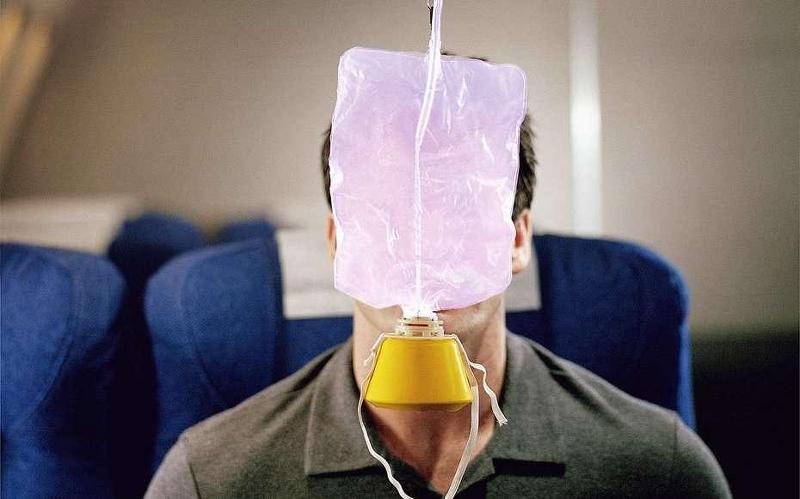
Do you know what to do if you’re on an airplane and there’s a sudden loss of cabin pressure? Scream? Pray? Scream prayers? All good suggestions, but if you had paid attention to the flight attendant before takeoff, you would know to “secure your own oxygen mask first before you help others.” Related image

If you are a caregiver—either as a volunteer or professionally—for someone facing a serious illness, my guess is that you probably could do a better job of taking care of yourself. Putting on your own oxygen mask first, if you will. And if you’re the patient and not the caregiver, my guess is that you probably could do a better job of understanding what caregivers do and feel.

Thankfully, I’ve never been on a plane which experienced a sudden loss in cabin pressure, but hearing a diagnosis of cancer or some other life-threatening illness certainly has a way of making you feel faint. And the weeks, months or even years of caregiving which follow can leave anyone weary.

So I chatted with my friend Cynthia about the crucial but exhausting role of caregiver because: 1.) She’s been doing it for a really long time and 2.) She’s written a really helpful book on the subject called Cancer Journey: A Caregiver’s View from the Passenger Seat.

Cynthia says her role as caregiver to husband Jim has endured much shifting throughout his 15-year journey with non-small cell lung cancer. Cynthia Zahm Siegfried's Profile Photo, Image may contain: Jim Siegfried and Cynthia Zahm Siegfried, people smiling, eyeglasses

“I had a hard time initially getting him to be honest and express his needs…,” she explains. “He would try to make light of his symptoms or…minimize them when we talked to the doctor.

“I finally convinced him that wasn’t helping him or me,” she adds.

Because Cynthia has been a caregiver for so long—through nine lung cancer recurrences, one go-round with prostate cancer, multiple surgeries and countless treatments—I asked her how she finds the physical and emotional energy she needs to care for Jim.

“Find a support group and it’s better to be in one just for caregivers if you can,” she says. “Then you can really express yourself instead of both trying to protect each other.

“That first year (after diagnosis) I didn’t really do a good job of taking care of myself.” Cynthia admits.

But in the intervening years, she says she has tried to play tennis or do Pilates/yoga a couple times a week. She also joined a community singing group which always lifts her spirits, and together she and Jim find stress relief by watching comedies and reading humorous books.

I’ve been a caregiver for family members—either unwell physically or mentally—for most of the past three decades. I’ve had a relative with dementia living in our home for years and I’ve made bi-weekly seven-hour car trips for months to be with a relative undergoing chemo. I’ve been so physically fatigued I had to literally crawl up the second-floor stairs and I’ve been so emotionally exhausted I’ve spent hundreds of dollars so I could pour out my woes to a counselor.

Being a caregiver is incredibly hard. I get it.

Image result for love your neighbor as yourself

But I also know we make the job even more difficult when we fail to take good care of ourselves. Do you know what Jesus said the two most important commandments are? First, “Love God with all your heart, soul, mind, and strength” and second “Love your neighbor as yourself.”

Don’t miss those last two words: “as yourself.” It doesn’t just say to “love your neighbor.” It says we need to love ourselves. In fact, we can’t really love other people if we don’t love ourselves.

It is not selfish of you to do something refreshing, rejuvenating or relaxing for yourself. You cannot “fill up” your loved one when you both are running on fumes. Somebody is going to stall and get rear-ended.

The most loving thing you may do for your loved one today is to be good to yourself. If you can’t leave your family member alone, this is the time to call in one of those offers of help that others have made.  Watch a funny movie, enjoy a massage, go fishing, get a pedicure, take a walk, hit a bucket of balls, or catch a nap. Do something to lift your spirits so afterward you can once again lift someone else’s.

Adapted from Peace in the Face of Cancer, copyright 2017 by Lynn Eib
+++++++++++++++++++++++++++++++++++++++++++++++++

(If the music video doesn’t automatically load below, click on https://www.youtube.com/watch?v=UUEy8nZvpdM

Helping Kids Cope with Cancer and Celebrating One Boy’s CURE


One of our church’s pastors, Matt, and his wife Carrie have been living in the shadow of cancer since December 2009, when their oldest child, Ian, was diagnosed with acute lymphocytic leukemia at the age of 3 ½ .

Matt vividly recalls the moment the doctor gave them the diagnosis. 

“Acute leukemia were not the words we expected to hear,” Matt says. “In my mind, I equated that (diagnosis) with death and I thought I was going to lose my son.”

Later that night after the frightened couple put Ian and younger brother Nathan, then 1 ½ , to bed they joined hands and “told God we fully gave Ian to Him,” Carrie recalls.

“We prayed for our marriage to be able to withstand the stress that was about to come upon us,” she adds.

Ian underwent six phases of aggressive chemotherapy over more than three years and was in and out of the hospital for treatment and its debilitating side effects.

I recently asked Carrie and Matt how they helped their young family, which now includes a daughter, Quinn, see God at work in the midst of this trial.

“We openly discussed our fears and when we felt alone and even distant from God,” Carrie explains. “We also served in our ‘cancer community’ by showing God’s love in practical ways to others who were suffering, too.”

A couple of years ago, Ian and his family loaded up their van to go out to eat and celebrate his third cancer-free anniversary. Carrie recalls:  “I noticed Ian sitting there with his eyes closed and hands folded. I wasn’t sure if he was praying, so I asked him if he was OK.”

“Yes,” was the young survivor’s reply. “I was just thanking God that I’m still cancer-free.”

On February 27, 2018–five years after Ian finished treatment– doctors officially pronounced the 11-year-old CURED! He and his extended family joyfully celebrated with a Disney cruise vacation.


Every year nearly 16,000 children in the U.S. are diagnosed with cancer and worldwide about a quarter of a million kids get that bad news. That’s a new child diagnosed with cancer every three minutes.

Statistics are not compiled for how many parents of minor children get cancer, but about 3.2 million of the U.S. adults diagnosed annually are ages 21-55 and therefore likely to still have kids at home. And that’s not even counting all of those cancer patients with young grandchildren.

However you add it up, there are a millions of families facing cancer with children.

So how can you best help the children in your life?  Fred Rogers has been quoted as saying: “Anyone who does anything to help a child in his life is a hero to me.”  So here are my recommendations written in an A- B-C style in honor of my hero, Mister Rogers:

  • Allow your feelings to be seen—even the sad ones. Obviously, it’s our job to help our children with their feelings, not vice versa, but if you want them to see how God is walking with you, you’ll need to share your struggles at times. It’s OK for children to know that sometimes we are afraid or angry or worried because then we can show them how a Christ-follower seeks God’s help with those feelings.
  • Be age-appropriately honest. Don’t tell all the statistics, but do use the word “cancer.” If you don’t, it may seem as if the word is too scary to even utter. It isn’t. Take away some of its supposed power by naming it as simply another illness. Sometimes when we don’t tell children the difficult truth, they imagine something even worse.
  • Create ways kids can give of themselves. Let them make cards or little gifts for the one facing cancer. Encourage them to pray specifically for that person every day. If the child is the one with cancer, follow Ian’s family’s lead and minister to others going through hard times. It’s so much easier to get our minds off our own troubles when we reach out to others.
  • Don’t make promises you can’t keep. We never told our girls “Mommy will be fine” because there was no such guarantee. We did promise them that the doctors would do everything they could to make me well, I would do everything to get well and that we expected I would become well.
  • Empower them by praying for them and with them—as in out loud and not just at mealtimes. Show them how to trust God even when we don’t like our situation. Don’t promise them that the one with cancer will be healed, but promise them that the One who created that person loves him/her with an everlasting love and will never leave them.

Facing cancer with children can be a wonderful first-hand lesson of the supernatural power of God in our lives. Help guide them to the path of peace as the Lord guides you there, too. The positive impact of this journey can be seen for generations to come.

Our children will serve Him;
future generations will hear the story of how the Lord rescued us.
They will tell the generations to come
of the righteousness of the Lord,
of what He has done. Psalm 22:30-31 The Voice Bible

Adapted from a chapter in Peace in the Face of Cancer, copyright 2017 by Lynn Eib.

(For parents with cancer, I recommend When a Parent Has Cancer: A Guide to Caring for Your Children by Dr. Wendy Harpham. For parents of children facing cancer, I recommend Chase Away Cancer: A Powerful Story of Finding Light in a Dark Diagnosis by Ellie Poole Ewoldt.)

If the music video doesn’t appear, use this link https://www.youtube.com/watch?v=Uy2EtG3UkL8


“Mother, PLEASE, I’d rather do it myself!”

  Anybody else old like me and remember the 1965 Anacin pain reliever commercial shown  here?  

I was a pre-teen when that commercial appeared on the screen of our little black-and-white TV (with the aluminum foil on the rabbit ears) and my mom and I thought it was hilarious. We would joke around and quote it to each other whenever one of us offered to do something for the other. But headache or not, I think most of us are I’d-rather-do-it-myself kind of people. That’s one of the reasons why it’s especially frustrating when serious or chronic illness hits us or those we care about. It’s not really in our nature to admit there’s something weighing us down and we can’t really fix it. How heavy is the load you are carrying these days? Are your arms weary from trying to hold up yourself or your loved one? Is your back breaking from the weight of medical bills piling up? Is your mind exhausted from trying to keep track of all the appointments and medications? Is your spirit feeling let down by the unfairness of life? Jesus has an exchange He’d like to make: your heavy burdens for His light one. Then Jesus said,”Come to me, all of you who are weary and carry heavy burdens, and I will give  you rest, Take my yoke upon you. Let me teach you, because I am humble and gentle at heart, and you will find rest for your souls. For my yoke is easy to bear, and the burden I give you is light.” Matthew 11:28-30 NLT

Notice He doesn’t promise to just take everything away so that we have no burdens? It’s as if right now we’re plowing through life as a single ox Image result for photo double yoked oxenwith a heavy yoke on our necks. When we give that big burden to Jesus, He comes alongside us, attaches His double yoke, and plows right with us.

No wonder our burdens are so much lighter and we are so much less weary! You don’t have to carry this heavy load by yourself. Lay down your I-can-do-it-by-myself yoke and allow Jesus to lighten the load as you walk side by side through whatever lies ahead.   Please enjoy this “oldie but goodie” song from 1975 by Chuck Girard, whom I had the distinct pleasure of interviewing back in the ’90s when he sang at Houghton College (and yes, I still own and listen to this album!). https://www.youtube.com/watch?v=LbLpncI4OvY